Sunday, March 27, 2016

NJ Ultra Festival 100: Pre-Race Thoughts

I'm in taper mode at the moment, which means that the time I would usually spend running is being spent freaking out about my upcoming race. In about a week, I will attempt to run 100 miles on a trail for the first time in my life. Yeesh! To ease my nerves, I thought it would be useful to write out my training and lay out some concrete goals for the race. Here goes...

Training

Despite some nagging Achilles tendinitis issues early in year, I ran my highest monthly mileage ever (255 miles) in February, and I'm on pace to match or surpass that mark again this month. Here's what my weekly mileage looked like for those months:

Week
Distance (mi)
Comments
2/1 - 2/7
73
First full week of running after 2 wks off
  2/8 - 2/14
71
Still feeling good!
2/15 - 2/21
67
2/22 - 2/28
44
Recovery week 
2/29 - 3/6  
70
  3/7 - 3/13
79
3/14 - 3/20
62
First week of taper 
3/21 - 3/27
31
Easy running from here till race day

Most of my training mileage came in the form of "medium-long" runs, as prescribed by Uncle Pete's marathon training plan. These runs were typically between 9 and 15 miles, with the first half of each run at about 9:00/mi and the second half at 8:20/mi.

I'm pretty happy with the mileage that I managed to put in over the past 8 weeks. My only concern is the lack of hill training that I was able to do. As my last hard workout on 3/19, I ran an 18 mile loop around Round Valley reservoir, which included 3,800 feet of climbing. It took my quads 4 days to completely recover, which is not a great sign considering the Ultra Festival course has 5x more elevation gain than that over its 100 miles. Oh well...

The Course

The NJ Ultra Festival has traditionally been held on flat trails, leading to blazing fast finish times over the past few years (2011, 2012, 2013, 2014, 2015). This year, the race organizers decided to mix it up and move the course to the Princeton-Blairstown Center in the foothills of the Appalachian Mountains. The new course now features over 16,000 feet of elevation gain and an equal amount of descent over sixteen 6-mile loops. [Note: the course was originally supposed to be a 10 mile loop, but one of the land owners backed out at the last minute]

Elevation profile for each 6 mile loop

For comparison, the tallest mountain in the lower 48 states (Mount Whitney) is 14,505 feet tall. For further comparison, the climb from Everest base camp to the top of the mountain is a paltry 11,500 feet (although, as I understand it, it's slightly chillier there than in New Jersey). The good news is that all this climbing will be excellent preparation for my A+ race in October - Grindstone 100 - which has over 23,000 feet of elevation gain.

Since the course is located entirely on private land, I have not been able to run any of it. However, the race organizers hinted that the trails there are comparable to the ones at Febapple, minus the FUS sections. This means that it should be fairly runnable terrain for me. On the other hand, this thing is apparently part of the course as well.

This should be fun at mile 98!

So it appears that this course will be a throwback to my obstacle race origins. As fun as that rope bridge looks, it might be a bit much for me after 20+ hours of running.

Race Strategy

As with all ultras, my main goal is just to finish the race. However, after weeks of preparation and some successful early season races, I want to make sure I get my money's worth. Here are my somewhat conflicting ideas on how I'll approach the event:

  1. Run patiently, but assertively: I don't want to burn out in the first half of the race and be forced to walk for the last 15 hours. But I also don't want to finish with the feeling that I didn't give 100%. This is a delicate balance in any race, but particularly so in 100 milers. Luckily, my finish at Febapple, where I maintained an 11:00/mi average pace, gives me a good indicator of my current fitness level.
  2. Let the terrain dictate my pace: One of my favorite features of Strava is the "Grade Adjusted Pace" (GAP) that is calculated for each segment of a run. GAP accounts for the fact that running uphill is harder than running downhill, so your uphill pace should naturally be slower than your downhill pace. In the case of this race, I want to run at about a 10:30/mi effort level for as long as possible, which might mean a 16:00/mi pace on uphills and 9:00/mi on downhills. Some of you might recognize 16:00/mi as a brisk walking pace - that's exactly what I plan to do! Walk the ups, bomb the downs, and maintain a steady pace in between.
  3. Even(ish) splits: In marathon running, the mark of a good race is running an even split, meaning the first 13.1 takes exactly as long as the second 13.1. In ultramarathon running, even splits are almost impossible because muscular fatigue eventually slows everyone down, regardless of how cautiously they ran in the first half. The most successful ultrarunners will typically slow down by 5-10% in the second half of a 100 miler. Mid-pack runners like me should usually aim for 10-20%.

Goals

In order of least difficult to most difficult
  1. Finish under the 30-hour cutoff: I have the fitness to finish the race, but ultras are unpredictable. A lot can happen in 100 miles, so this has to be my bottom line. Barring injury or a lightning strike, this should be doable.
  2. Sub-24 hours: This is the holy grail of ultramarathons: 100 miles in a day. Gordy Ainsleigh was the first person to do it back in 1974, and thousands more have done it since. That doesn't mean it's easy.
  3. Sub-22 hours: This would be close to my TGNY100 time from last year, but on a much harder course. This is a stretch, but it's within the realm of possibility based on my recent races. If this happens, it means every part of the race has gone perfectly for me.
  4. Win the damn thing: I'm not going to chase the front-runners if they set a quick pace at the beginning of the race. But you better believe I'll push hard if I'm within spitting distance of them around mile 80.

And lastly, here's my ideal pacing strategy for the race, based on the original 10mi loop course. My times will probably be slower on the new course, which has more elevation gain and river crossings. [My original #3 goal was sub-20, but that is much less likely in the new course]

Distance (mi) Pace (min/mi) Lap Time Total Time
10
11:30
1:55
1:55
20
11:30
1:55
3:50
30
11:30
1:55
5:45
40
11:30
1:55
7:40
50
12:00
2:00
9:40
60
12:00
2:00
11:40
70
12:00
2:00
13:40
80
12:00
2:00
15:40
90
13:00
2:10
17:50
100
13:00
2:10
20:00

Tuesday, March 15, 2016

A Short Race and a Long Training Run

Two mostly unrelated thoughts from this past weekend:

  1. Racing is hard, regardless of distance
  2. Running through New York City never fails to entertain me

Here's how I came to those conclusions.

Looney Leprechaun 10K (Saturday)

For the past few years, Alex and I have had a tradition of running holiday-themed races, usually with Alex's mom Julie. Starting with the Hangover Run on New Year's day and finishing with the Christmas City Classic in December, we usually manage to hit most of the big holidays. So of course when we heard about the Looney Leprechaun 10K trail race in Tyler State Park, PA, the three of us had to run it.

Hangover Run 5K, Revolutionary Run 10K, and Christmas City Classic 5M

Those of you who follow this blog (Hi Mom!) will know that I've mostly been racing ultras over the past few months. Combined with the fact that I've been avoiding speed work due to a recurring achilles tendinitis issue, this means that I now have no idea how to pace myself at shorter distances. It will soon become apparent to myself and everyone else that "as fast as possible" is not a sustainable pace.

Race day was sunny and warm (for March), with a high of over 60 degrees. I lined up near the front of the pack at the starting line, figuring I was at least capable of a top ten finish in a race this small (150 starters). The starting gun fired and we took off. Two men immediately went to the front of the pack. The pace felt manageable, so I stayed a few strides behind them.

For short races, I have my GPS tell me my splits every half mile. So half a mile into Looney Leprechaun, my watch beeped at me and displayed 0.5 mi, 3:02. Well shit. A 6 min/mi pace? I can barely run one mile at that pace, let alone 6.2 miles. This race was going to hurt.

I am not a smart man.

As those thoughts were going through my mind, the eventual race winner blazed by me, putting me in fourth place. I tried to do some damage control and let my pace slow a bit, and the three lead runners all pulled away, never to be seen again. The course wound its way downhill through rutted fields and along a fun stretch of single track with views of the Neshaminy Creek. We eventually crossed the creek on the beautiful Schofield Ford Covered Bridge. My pace naturally slowed a bit on the technical trails, but I felt like I was still going strong.

Schofield Ford Covered Bridge

Just past the half way point, the course climbed a short but brutal hill which forced me to walk. I couldn't believe it. I've never walked in a 10K. This course was no joke! I got back to running, and the course passed back across the bridge and returned to the rutted fields and the long uphill path to the finish line.

I had been running by myself ever since falling to fourth place, so the sound of footsteps behind me at mile 5 was as clear as day. I was being stalked. I was low on energy, but hated the idea of being passed this close to the finish line. I pushed hard on the uphill, but the other runner stayed right on my heels. My lungs burned. I was breathing fire. Eventually, I gave in and let him pass me. As luck would have it, a photographer was standing at the top of the hill and captured this exact moment.

*Jaws theme* Dun dun. Dun dun. Dun dun dun dun dun dun DUN DUN!

"Nice job," I said to the other runner. "I hate you," I mumbled under my breath.

He put some distance between himself as we continued to climb. That was probably my penance for going out too hard in the first half mile. I bombed down the ensuing downhill trying to catch up, but it was too little too late. I crossed the finish line 30 seconds behind him in a time of 47:18, good for fifth place overall and 1st in my age group.

At the finish line, I spent some time chatting with the runner, whose name is Steve. It turned out that Steve and I had both run the Bucks County Marathon back in November, where I set my PR (he beat me at that race too). He was a cool guy, so I guess I can forgive him for passing me in such heartbreaking fashion. Together, we ran a short cool down back along the course until I met up with Alex, who seemed to be feeling good. I paced her in to a solid finish in 1:06:57, good for 7th in her age group. Julie came in a few minutes later in 1:09:06, also 7th in her age group.

The post race festivities included a delicious pancake breakfast, during which I got my age group award ($20 Wawa card. Woo!). But more importantly, I refueled with bacon. We also got a coupon for a free beer at the local bar, which we took full advantage of.

Mmmm... bacon!

So another fun race is in the books. My streak of consecutive third place finishes has ended, but I ran a strong overall race and got to enjoy a new set of trails. I also reminded myself how much a 10K could hurt.


TGNY100 Training Run #1 (Sunday)

After a nearly sleepless night (daylight saving cost me an hour), I woke up at 5am on Sunday morning to make the long trek into New York City. Despite my sleepiness, I was excited for the first group training run for The Great New York 100 Mile Running Exposition.

During the spring, race director (and American record holder) Phil McCarthy organizes four group training runs for TGNY which allow runners to learn the course and get acquainted with each other. The first training run is a beast: 35 miles from the starting line in Times Square to scenic Randall's Island in the East River. The remaining are all much more manageable at 18-26 miles apiece.

For me, this run was also an opportunity to see friends that I made during last year's training runs and race. In particular, I was looking forward to catching up with Charlotte Dequeker and Ke'mani Smith. The three of us were 100-mile virgins during last year's training runs, and we bonded over our shared ambitions and fears for the upcoming race. Charlotte and I shared a few miles late in TGNY when we were both too tired to run. We finished within 30 minutes of each other. Ke'mani and I had run together earlier in the race until a torn quadriceps muscle began to slow him down. He nevertheless finished the race, proving that ultrarunners are a remarkably strong and stubborn bunch.

Times Square is amazingly empty at 8am on a Sunday. Picture taken by Tiger Ellen Nguyen.

We all met at 8am at the TKTS booth in Times Square, and at 8:15 we were off. We split into a 9min/mi group and an 11min/mi group. It took some time to settle into a steady pace. An 8:22 mile early on made we worry that I was not going to be able to keep up with this group. But eventually, we slowed down a bit and got into an easy rhythm.

At mile 11, we stopped at Twin Donut to grab some snacks and use the restroom. I really wanted to get one of their famous giant donuts, but I was afraid that I would have to taste it for a second time a few miles later (if you catch my drift). Instead, I bought a banana, mostly to satisfy the manager who repeatedly scolded us that the bathroom was for customers only. At this point, we also met up with Tommy Pyon, who has won the three previous TGNY 100 races (as well as a bunch of other ultramarathons over the years). We also bumped into Grant McKeown, who helped organize training runs last year and volunteered at the 100K aid station during the race.

The 9 min.mi gang. Picture taken by Grant McKeown.

I'll spare you the details of the course, since I already devoted an entire race report to doing just that. But it's always fun to run through New York City, and it's even more fun to do it with friends. I talked to Ke'mani and Charlotte about their race schedules for the year (we're all running TGNY again). I found out why Phil moved to New York City from his home state of Nebraska (short answer: music). I picked Tommy's brain about pacing the NYC Marathon and getting sponsorships. And we passed by an infamously overdecorated house, which Phil immortalized in his holiday card to the TGNY runners.

Never a dull moment in NYC!

We stopped briefly at Orchard Beach at mile 23, where I sat for too long and tightened up ("Beware the chair." -Phil). We continued on our way and made a pit stop at a convenience store around mile 27, where I bought the biggest bottle of water I could find and immediately chugged almost the whole thing. I spent a few miles talking to Keila Merino, who won the first TGNY in 2012, finished the Grand Slam of Ultrarunning (Western States, Vermont, Leadville, and Wasatch) in 2014, and is planning to run across the US this summer. I led the pack for a while, trying to remember where to turn (gotta hone those navigation skills).

At mile 35, we got to explore a new part of the course - the newly completed pedestrian path from the Bronx onto Randall's Island. 

The Cathedral (No, that's not it's name. That's just what I call it)

Then after a short 35.3 miles and 6 hours of running, we were done. Charlotte, Ke'mani, and I walked together across the Triboro Bridge and back into Manhattan, where we parted ways. I stopped at a deli and got the most delicious turkey sandwich and Coke that I've ever had, then hobbled to a subway station to begin the long trek home.

Thus ended a long weekend of running (and my first 80 mile week of the year). My legs still feel good, which gives me some confidence going into my first 100 miler.

With the NJ Ultra Festival now less than three weeks away, I'm starting my taper. At some point I'll probably put up a pre-race post with some goals and logistics, so keep an eye out for that.

Thanks for reading!

Friday, March 11, 2016

Lenape Trail Run

Do you ever question your orientation? I do it all the time.

...let me rephrase that...

Do you have a poor sense of direction and get lost easily? Because some days I feel like I need a map and compass just to find my living room.

This is a story about my navigation abilities, or total lack thereof.

Run Fat Ass, Run!

The Lenape Trail is a 34-ish mile trail that connects Newarks Ironbound district to South Mountain Reservation in Millburn, making an inverted U across northeastern NJ. Named for the Lenape tribe that used to occupy most of the state of NJ, the trail consists of roads, rail trail, and some technical single track sections near the end. In principle, the trail can be followed by looking for yellow trail blazes on utility poles and light stanchions. In practice, the blazes are old and faded or otherwise hidden by bushes, snow banks, pamphlets, etc., making navigation a serious issue for people who are not familiar with the course.

The Lenape Trail

The race was designated as a "Fat Ass" run, which means that there were no additional trail markings, aid stations, crews, or spectators. The internationally accepted rules of a Fat Ass are No Fee, No Aid, No Wimps. We were on our own. So at 6:30am on a chilly Saturday morning, 21 intrepid runners met at the western terminus of the Lenape Trail, parked their cars, boarded a train for Newark, and set off on an urban ultra adventure, carrying everything they would need for 34+ miles of running.

A Short History Lesson

Those of you who are from the northeastern US might recall that the winter of 2014-2015 was, for lack of a better phrase, cold and snowy as shit. At the March 2015 running of the Lenape Trail Run, 18 inches of snow blanketed the Lenape Trail, with drifts that were more than two feet deep in some places. In one particularly snowy section, my GPS log from that event shows that I "ran" a 19 minute 20 second mile which was almost entirely downhill. The winning time, and I should remind you that this is only a 50K, was 7:24. What I'm saying is, it was not a fast course.

Fast forward to the present day, and the weather was almost perfect. The snow from the January and February storms had completely melted, and the forecasts were calling for 40 degree weather and partly sunny skies. The previous course record of 5:16, set during the snowy 2013 race, looked poised to fall.

The Race Is On

After arriving in Newark, we all took turns violating the tiny bathroom in the train station while a homeless man gave himself a sponge bath at the sink. I distinctly remember staring at an abandoned pair of crutches, streaked with fresh blood, leaning against the wall of the bathroom stall while I attempted to complete my pre-race ritual. Ah, Newark!

After a short pre-race briefing by race director Christian Focacci and a couple quick pictures (which will be uploaded when I receive them), we made our way out to the sidewalk and quietly started the race without so much as a ready-set-go. In attendance was Eastern States 100 runner up Jay Lemos, 3:03 marathoner Jason Friedman, Frozen Fools runner up Chris McGovern, Febapple 50K winner Kait Sheridan, ultra veteran Chipp Winston, and NJ Trail Series race director Rick McNulty.

My plan for this race was to go out hard in the early road miles as sort of a tune up for the NJ Marathon in early May. I carried four 20oz. bottles of Tailwind in my Ultimate Direction vest and brought a few other snacks just in case. My biggest decision leading up to the race had been which pair of shoes I would use. I had been logging lots of road miles in my Brooks Glycerins, which were the only shoes that seemed to keep my achilles tendons happy. On the other hand, they would have absolutely no grip during the technical trail sections later in the race. I opted to protect my tendons, and brought the Brooks. This would turn out to be a pretty good decision. But the best decision of the weekend was printing out turn-by-turn directions onto four strips of paper and wearing them on my wrist, an idea first thought up by my permanent crew chief (also, wife) Alex Thorpe to keep me from getting lost at TGNY.

Just a few turns

Speedster Jay Lemos immediately took off like a shot, never to be caught by anyone else. My Strava stalking detective work shows that he was running 7:30ish miles on the early road sections. Too fast for my slow legs to keep up. I chugged along at an 8:30 pace, losing sight of him within 2 miles of the start. I briefly pulled ahead of the pack, but I was quickly reeled in by Rick McNulty and Chipp Winston as we entered Branch Brook Park. The three of us worked our way through the paved footpaths of the park together until we came out to a 5-way intersection. My direction bracelet told me to make a right, but it didn't say whether it was a sharp right or a slight right. While I was trying to make up my mind, Chipp and Rick picked a direction and ran off. By the time I realized they were right, they were a minute ahead and the pack had caught up to me again. "That's my one navigational mistake for the day," I told myself. Feel free to start laughing now...

The trail wound its way across Booth Park in Nutley, westward through a residential area, and then crossed the Garden State Parkway on a footbridge. Around mile 9, I found myself running with Jason Friedman, whom I had shared some miles with at last year's event. I had been having severe digestive issues that year, and he had a hip issue that forced him to power walk much of the race, so this year's race felt like a chance at redemption for both of us. Distracted by our conversation, we quickly missed the entrance for Brookdale Park (mile 10), and had to find a side entrance to get back on the Lenape Trail. Mistake number two.

By mile 12, we had made another wrong turn and somehow found ourselves on the Lenape Trail, but running in the wrong direction. Using my handy direction bracelet, I managed to correct the mistake, but not before we had added an additional half mile to our race. Mistake number 3. Mile 13 is where the trail goes off road, starting with a 250 foot climb up to Cedar Grove Reservoir. My road shoes slipped a bit in the mud as I climbed, but I told myself that this short section was a small price to pay for the comfort during the road miles. At the top of the climb, the New York City skyline appeared off to the east, clearly visible in the crisp winter air. I caught up to and passed Rick in this section, who was in good spirits, but told me that he had gone out too fast and was suffering the consequences. He also mentioned that Chipp was having trouble navigating, and I would probably come across him soon.

The woods were a welcome reprieve from the noise of the city streets, and the trail lazily wound its way around the reservoir, concluding with a very cool section along a ridge, which was bounded on both sides by a small stream. However, I once again managed to add a few tenths of a mile to my route by missing a turn in this section.

This is my jam! Photo credit: http://arunaday.com/

Now running alone and in 3rd place, the miles ticked away as the trail followed a gas pipeline through flat runnable terrain for miles 18 and 19. At mile 20, the trail abruptly turned onto the road again, and I wound my way through residential streets and into downtown Verona. It was here that I had spent 15 minutes walking in circles last year, confused by a left turn blaze placed a quarter mile before the actual turn. Now armed with my trusty direction bracelets, I competently stayed on the trail. Nothing could stop me now!

At mile 20, the trail entered Verona Park, and made almost a complete circle around Verona Lake before exiting the park. It was here that I finally caught up to Chipp, who had run a complete 1 mile circle around the lake and ended up back where he started, having never seen the turn. Navigating together, we eventually found the poorly marked blaze that led out of the park and into another residential area. I was glad to have company again, and we chatted about our common goal of getting accepted in the Western States 100 lottery. We again missed a turn and ran an extra quarter mile, but laughed it off as a harmless mistake (#4).

Around mile 22, the trail entered Eagle Rock Reservation for a few miles of fun semi-technical single track. I had to watch my footing, since my shoes afforded little traction on the wet rocks that littered the trail. But otherwise, this was an enjoyable section. We hit the end of the trail and came out onto Eagle Rock Ave., a developed area with strip malls and gas stations. Now back on even footing, Chip and I were able to relax and let our guard down... and then we missed another turn. Mistake number 5 was a doozy. We went 0.7 miles past our turn and went down a 200 foot hill. This mistake added 1.4 miles and a whopping 15 minutes to our run. During this detour, Jason Friedman and Chris McGovern both passed us, and Kait Sheridan caught up to us. Frustrated, but determined to finish strong, Chipp and I got back on the course, now running in fourth place with Kait.

Now on the last stretch of road before the re-entering the technical trails, I ran a few quick miles (8:18, 9:18, 8:24) to try to regain some lost time. Around mile 29, we turned off the road for the last time and climbed up Mayapple Hill. At the top of the hill, the race director's dad had set up an aid station out of the trunk of his car (a rare and miraculous occurrence for a Fat Ass run!). I pulled into the aid station just as Jason and Chris were leaving. I had just run out of water during the climb, so I needed to stop and refill. Within a minute, I was back on the trail and in pursuit of a podium spot.

Pushing hard with only a few miles left to go, I caught up with Jason and Chris soon after the aid station. We ran together for a mile or two. I surged a few times, but Jason was on his home turf, having trained extensively on the Mayapple trails. I couldn't get more than a few strides ahead of him. Then he made his move. Remember the icy FUS section from the Febapple 50?

Yeah. This crap again.

Mile 32 of Lenape went straight up this same hill, which had since thawed and was covered with ankle-deep mud and standing water. Jason flew up this climb, never breaking stride. I'm not a great uphill runner to begin with, and in my slippery road shoes I steadily lost ground to him until he disappeared over the top of the hill. I reminded myself that there were still two miles to go, and that I could still catch him on the technical downhill sections. As luck would have it, that's exactly what happened on the next downhill. Unfortunately, it only happened because Jason had stopped to pet a dog that was walking along the trail. Maybe I was taking this race more seriously than he was...

Well, I wasn't going to let that stop me. I pushed hard for the next mile, only to have Jason pass me decisively on the next climb. Seriously, it felt like I was standing still as I watched him disappear ahead of me for the second time in a two mile stretch. I was in awe. And also very frustrated. Now with only half a mile left, I had almost no chance of catching him. On the other hand, I was now comfortably ahead of the runner behind me as well. For the second race in a row, I trotted in for a 3rd place finish. My final time was 5:49:16, almost exactly an hour behind race winner Jay Lemos, who shattered the previous course record.

My final distance for the day was 35.4 miles. I figure I lost between 20 and 30 minutes to various detours throughout the course, which probably cost me second place. On the other hand, I got a sweet trophy that was hand made by Jay (who incidentally finished so far ahead of us that he was able to go out and buy beer and coffee before the rest of us finished).

Smiling with my new hardware. Note the yellow Lenape Trail blazes.
After the race, we sat around for a few hours watching the rest of the runners trickle in. Chris McGovern finished less than a minute behind me, proving that my lead was not as substantial as I thought. Kait and Chipp finished together in 6:03. For Kait, it was her second straight 50K win. Chipp, on the other hand, won the unofficial highest mileage award, with over 38 miles for the day.

Altogether, this was a fun little race. I always enjoy the low key atmosphere and camaraderie of local Fat Ass events, although I should probably learn to stay on the prescribed course. I would like to thank Christian for organizing the event, his father for providing the much needed aid station, and Jay for making the trophies and buying post-race beverages.

3 weeks till NJ Ultra Fest 100...

More pictures from the event can be found here. Results are here, and my Strava log is here.

Tuesday, February 23, 2016

Febapple Frozen 50

Off to a great start


"God! Damn it!" I yelled to no one in particular.

I had just tripped over a rock and sprawled out onto the trail, slamming my right kneecap into another rock as I fell. Pain radiated down my leg as I got back on my feet. I glanced down at my GPS. Mile 12. I had 38 more miles to cover, and I had just incapacitated myself.

Let's back up a bit


The Febapple Frozen 50 is a trail race organized by the NJ Trail Series, whose stated mission is "to make running fun again." To that end, founders and race directors Rick and Jennifer McNulty always choose interesting and often highly technical trails for their races. They warn on their Facebook page that "These will not be PR courses."

The course for Febapple was a 10 mile loop consisting of a mixture of technical single track and smooth fire roads. Runners had the option of running 10M, 20M, 50K, or 50M. With a 100 miler coming up in April, I decided to run the 50 miler as my tuneup race to make sure my training, nutrition, and gear were all up to snuff. My primary race goal was to avoid re-aggravating my achilles tendinitis, which had forced me to stop training for two weeks earlier in the year. My secondary goal was to run conservatively early on and to keep my 10 mile splits as even as possible. However, I gave myself permission to run with reckless abandon at the end of the race if I had a chance to win.

At precisely 7am (Rick always starts his races exactly on time), the 50 milers were off. The starting field consisted of 28 runners of various abilities and backgrounds. Among them (according to my internet stalking) were Barkley 100 finisher (yes, that Barkley!) John Fegyveresi, 2:43 marathoner Jamie Stroffolino, 2:55 marathoner Jonathan Warner, and last year's 4th place finisher Jesse Wolfgang. This would be the most competitive ultra I had raced since the Barkley Fall Classic (no, not that Barkley) back in September 2015.

The start of the Febapple 50. I'm on the left in the bright yellowish-green shirt.

The first mile of the course was a very runnable section of double-wide packed dirt trail. The field went out at a quick pace, the lead runners vanishing from my sight within a mile of the start. I tried to hold back, reminding myself to run my own race. My first two miles came in at 8:41 and 8:32 - probably too fast, but not a suicidal pace. I power-hiked the first climb while a steady stream of runners passed me. By mile 3, more than half of the starting field was ahead of me and out of sight. I promised myself that I would pass most of them back before the end of the race.

I got my first chance to do so around mile 5, when the course went down a steep single track section that was covered in ice. At this point, it is useful for me to introduce a term to describe the terrain in this section. Nick Hollon coined the phrase when talking about several root-strewn section of the HURT 100 course - "fucked up shit." To keep this blog at a PG-13 rating, I'll abbreviate this as "FUS" from here on.

FUS

So anyway, we got to the FUS section of the course at mile 5, and I immediately felt like I should have brought ice skates. I did my best to stay off to the side of the ice, but the trees and rocks lining the trail forced me to constantly jump or slide across the slick path. It was like running on a slip and slide. Any missteps left me sliding down the trail, flailing my arms wildly in hopes of snagging a tree branch. Despite how awkward this section felt, I managed to flail my way through it faster than a few other runners, slowly moving up in the field.

Beyond the FUS was the mile 6.5 aid station, which marked a transition from single track to fire road for a few miles. I managed to throw down a few quick miles (8:40 and 9:26) before the course wound its way up a long climb back to the start/finish area. I finished my first loop in a respectable 1:45 (10:30/mi), still well behind most of the other runners, but feeling strong.

I'm not superstitious, but I am a little stitious


I would like to pause the ongoing story to tell a relevant anecdote. Back at the 2014 Frozen Fools 50K, I was running with another guy early in the race. Almost the entire course followed the Appalachian Trail, so all we had to do was follow the white trail blazes on the trees. Well this other guy was having trouble staying on course. He was constantly missing turns and wandering off the trail. When he stopped to take a leak, I pulled away from him, thinking to myself "This poor bastard is definitely going to get lost out here." I don't believe in karma or cosmic justice, but within minutes, I had unknowingly taken a wrong turn. I followed the wrong trail for over 3 miles down a steep hill before realizing my mistake. By the time I got back on course, I had lost 90 minutes of time and had run an extra 10K. I finished in last place, barely ahead of the course sweepers.

So you would think that I learned my lesson about judging other runners. You would be wrong. Early in lap 1 of Febapple, before we got to the FUS section, another runner was complaining to me that there were - and I quote - "so many rocks." I thought to myself, "Yeah dude, it's a trail run. What were you expecting?"

Around mile 12, I was replaying the conversation in my head, as one does. I was pitying the poor runner, because he was probably struggling with all the rocky sections of the course. He wasn't a seasoned trail runner like me. Do you see where I'm going with this?

Trip. Fall. Splat. "God! Damnit!"

Justice was swift, and it was brutal.

For the record, I'm usually pretty stable on my feet. Probably because of my low center of gravity and sturdy legs (thanks, viking ancestors!). But for some reason, I had tripped and fallen almost the exact same way on a training run only a week prior, banging my right shin on a rock. So here I was, a quarter of the way into my first ultra of 2016, and my right leg already felt like garbage. I couldn't believe it. I took a few tentative steps. My knee almost buckled under my weight. I stood there feeling sorry for myself for a minute. Ryan you suck. Ryan you suck.

I took a few more steps, and the pain began to dissipate. I took another look at my knee, expecting to see exposed bone and blood streaming down my leg. Instead, I saw a little scratch and a single droplet of blood. I shuffled forward a few more steps, carefully avoiding the rocks in the trail. With each step, the pain subsided a little more. I began to realize that I was probably fine.

"Okay Ry, let's try not to do that again." I promised myself.

The race is on


With my new found confidence that my leg didn't need to be amputated, I continued on. I patiently walked all of the uphill sections, but made up time on the flats and downhills, where I was able to maintain a consistent 9:00/mi pace.

Moving well on the runnable sections

It was difficult to tell what place I was in because the other races were all being run simultaneously, but I was pretty sure that no 50 milers had passed me since the first loop. I made quick work of the aid stations, stopping only long enough to swap out water bottles and occasionally kiss my crew chief. Aside from an emergency bathroom break, the details of which will be omitted from this post, loops 2 and 3 were fairly uneventful. I walked the uphills, ran the flats, and picked off runners one by one in the FUS. Lather, rinse, repeat.

The best kind of aid

Around mile 33, I caught up to running buddy Ke'mani Smith, who had finished TGNY100 in 2015 on a torn quadriceps muscle. He had chosen the Febapple 50K as his first trail race and was characteristically in good spirits, although he regretted not buying a pair of trail runners. He had shared some early miles with another friend and TGNY alum Charlotte Dequeker, who would go on to finish 3rd woman in the 50K. After running by myself all day, it was nice to share some miles with a friend and hear good news about another one. We chatted about training and the perils of trail running while we power hiked a big climb. At the top of the climb, we parted ways. Ke'mani would go on to finish in 6:40, a very respectable time for his first trail race.

Shortly after leaving Ke'mani, I spotted another 50M runner ahead on the trail. Now I don't often find myself "racing" in ultramarathons per se. Usually I just go my own pace and hope for the best. But my legs still had some life in them, and I wanted to do something fun. So I did my best Scott Jurek impression and hammered out an 8:30/mi pace for a half mile to pass him with authority. That felt good. Once I was comfortably out of sight, I let my pace slow back down and trotted into the mile 36.5 aid station, where Alexandra Thorpe informed me that I was now in 3rd place! The bad news was that the 2nd place runner was Barkley vet John Fegyveresi, who looked strong and was gaining on first place runner Jonathan Warner. What are the odds that a Barkley 100 finisher knows how to finish a race strong?

With renewed purpose, I set off at a strong pace, hoping to reel in the other two runners. However, I had failed to ask how far ahead they were. Spoiler alert: they both had an insurmountable 20+ minute lead on me with only 13.5 miles left to run. I ran the next 10 miles as quickly as my tired legs would carry me, but didn't see either of the two lead runners. When I got back around to the aid station at mile 46.5, I was disappointed but also relieved to hear that they were still 20-30 minutes ahead. That, combined with the fact that no runners were close behind me, meant that I could just coast in for the last 3.5 miles and enjoy the scenery.

Frozen waterfall at mile 9, 19, 29. 39. 49

I spent the last few miles of the course enjoying the unseasonably warm weather. I paused briefly to look at the half frozen waterfalls that lined the trail. I listened to the birds chirping, the sound of the streams, and the cool breeze blowing through the bare trees. When I crested the top of the final climb, I had a renewed energy, and I picked up my pace as I neared the finish line. I caught a glimpse of Alex and broke into a full "sprint," briefly hitting 6:30/mi. I crossed the finish line in 3rd place with a time of 9:17:16, which is a full hour faster than my previous 50 mile trail PR.

And the crowd goes wild!

Apparently I missed a spectacular finish at the front of the pack, as John Fegyveresi barely edged past Jonathan Warner to win by 25 seconds (8:49:29 vs. 8:49:54)! After my dawdling, I finished almost 30 minutes behind both of them, and the 4th place runner was another 18 minutes behind me. I was grateful for the opportunity to enjoy the last few miles without worrying about passing or being passed.

Closing thoughts


Overall, this race was exactly what I wanted it to be. I ran my own race and stayed fairly consistent from start to finish. My 10 mile splits were 1:45, 1:48, 1:51, 1:54, and 1:59. I could have run a little faster if I had pushed myself at the end, but I'll save that effort for my "A" races later in the year. My nutrition and gear all worked perfectly. I never felt nauseous and I finished without a single blister on my feet despite the wet and muddy condition of the course.

Alex, Jackie, Elaine, and Otto at the mile 6.5 aid station

I would like to thank my beautiful and supportive wife Alex for crewing me all day by herself. I am also grateful for aid station volunteers Elaine Acosta and Otto Lam, whose enthusiasm and positivity were infectious. Both highly accomplished ultrarunners, they went above and beyond to provide runners with water when their aid station ran out late in the day.

As a final aside, accomplished marathoner Jamie Stroffolino went through a rough patch with 6 miles to go. His girlfriend (wife?) Jackie, pictured above, had crewed him all day and absolutely refused to let him quit. Apparently someone had told her about Alex pushing me to finish last year's Wildcat 100K (for which I am still grateful). So to make sure Jamie finished the race, Jackie paced him in to the finish, running her longest distance ever in the process! Runners are awesome!

Thanks for reading!

Strava log and official results can be found at these links.

Photo credits: Alex Thorpe, Elaine Acosta, and Lisa Simone

Fuel and gear


Fuel: Tailwind Nutrition (250 cal per hour, mixed with 20 oz water)
Shoes: Altra Lone Peak 2.5
Socks: Injinji compression OTC
Shorts: Nike Phenom 2-in-1
Vest: Ultimate Direction SJ
GPS: Suunto Ambit2 S

Monday, February 8, 2016

Why Running Sucks: a handy guide

Runners love to extol the virtues of running - the health benefits, the camaraderie, getting to be outdoors. Hell, we might even wax poetic about the mythical runner's high. But let's face it, running sucks. Your lungs burn, you get all sweaty and smelly, and your muscles get tired and sore. Here's a handy guide to keep track of the reasons why running sucks, sorted by race distance and illustrated for your sick amusement.

6 Miles or Less

How running sucks: Burning sensation in lungs, heart beating out of your chest
Mid-race thoughts: "Why *gasp* did I *gasp* run that first mile *gasp* so f$&%ing fast?"
Why running sucks: You're hitting the limit of your VO2 max, which determines how quickly your lungs can take in oxygen and transport it to your muscles. In response to this, your heart rate and breathing both speed up. Which just sucks, doesn't it?
The solution: Run more. Training (sprints in particular) increases your VO2 max, making your heart, lungs, and muscles more efficient. Then on race day, you can suffer at a faster pace.

This guy knows what I'm talking about.

6-18 Miles

How running sucks: Burning sensation in your legs
Mid-race thoughts: "I'm pretty sure my quads are on fire. Or they're going to explode. My quads are going to catch on fire and explode. In that order."
Why running sucks: You're hitting your lactate threshold. Lactic acid is accumulating in your muscles faster than it can be metabolized, which causes a burning/stinging sensation. Some people believe that this causes delayed onset muscle soreness (DOMS). These people are wrong.
The solution: Run more. Interval runs teach your muscles to metabolize lactic acid faster, allowing you to race faster, and suffer faster.

Note: if your legs are actually on fire, consult a physician.

18-30 Miles

How running sucks: Weak feeling in legs, loss of motivation
Mid-race thoughts: "I must have missed a turn. There's no way the race is really this long. I need to walk for a few minutes."
Why running sucks: You're suffering from glycogen depletion, also known as "bonking" or "hitting the wall." Your body stores sugar in the form of muscle and liver glycogen. You have enough for about 18 miles of running. If you do not eat enough carb-rich food during the race, your body begins to burn fat. This is less efficient than burning sugar, causing you to slow down.
The solution: Run more (and eat more). Training increases your running economy, allowing your glycogen stores to last longer. Eating sugar-rich foods (like gels and sports drinks) during a race replenishes glycogen as well. This allows you to run faster and suffer your way to a better finishing time.

It sort of feels like this.

30-50 Miles

How running sucks: Sharp pain in leg muscles, nausea, general fatigue
Mid-race thoughts: "I need a quick nap before I keep going - twelve hours ought to be enough. I hope there's a saw at the next aid station so I can hack my legs off."
Why running sucks: Muscle fatigue and muscle damage accumulates during a race, especially from eccentric muscle contraction on hilly courses. Lack of blood flow to the digestive tract makes it difficult to process food, leading to nausea and digestive issues. Also, you probably missed nap time, which would make anyone sleepy.
The solution: Run more. Training strengthens your leg and core muscles, allowing them to better withstand the impact of multiple hours of running. Hill training can also improve your running form, allowing you to run your race faster and suffer your way to a podium spot or age group award.

This looks like a comfy spot.

50-100 Miles

How running sucks: Existential dread, hatred of running/life
Mid-race thoughts: "I could be having a barbecue right now. What am I doing with my life? Will I ever feel happiness again? Does happiness even exist?"
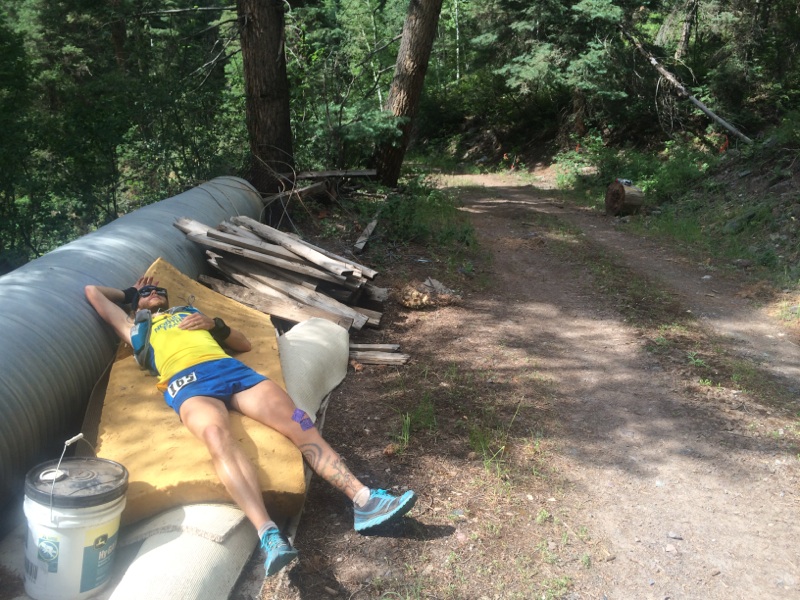
Why running sucks: Mental fatigue sets in at some point in every long race. This is your body's way of politely asking for some rest. Some ultra runners refer to the extreme low point of a race as the "pain cave," where negative thoughts almost overwhelm your mind.
The solution: Keep running. These low points are temporary. Eventually they pass, and running becomes enjoyable (or at least more bearable) again. Mental toughness is also improved through training, allowing you to run faster while you're in the pain cave.

Lying in a pile of garbage is not a recommended way to recover.

0 Miles

How (not) running sucks: Crankiness, boredom, inability to sit still
Mid-(not)race thoughts: "I really wish I was running right now."
Why (not) running sucks: Withdrawal
The solution: Go for a run. Or if you're injured, get healthy. Then go for a run.

Do you wanna build a snowman do a trail run?

In conclusion, running is terrible. The only thing worse than running is not running.

Print this list and keep it with you. Then when your friends invite you to run a 5K, 10K, or the Self Transcendence 3100 Mile Race, you can tell them in scientific terms why that's a terrible idea.

Thursday, January 14, 2016

2015 in Review and 2016 Goals

Presidential Traverse, August 29, 2015

2015 in Numbers
Total Mileage: 2,350 miles (3782 km)
Time Spent Running: 415 hours (17 days, 7 hours)
Number of Races: 27
Number of Marathons + Ultramarathons: 11
Personal Bests Set in 2015
   Distance
  Time
Pace (min/mi)
   1 mile
5:51
5:51       
   5K
19:47
6:22       
   10K
43:30
7:00       
   13.1
1:37:23
7:26       
   26.2
3:24:44
7:49       
   50K
4:45:00
9:12       
   50M
7:44:39
9:18       
   100K
12:12:00
11:47       
   100M
21:53:04
13:00       

The Year of the Ultramarathon: 2015 Highlights
While my first two ultras were back in 2014, it wasn't until 2015 that I had my first "good" ultra races. Between these big races, I had plenty of shorter events and some challenging training runs. Here are some of the more memorable runs.

Watchung Winter 50K (1/3) was a huge turning point for me, because it was the first time that I was able to finish strong in an ultra. On a mild snowy day, I started out at a conservative 11:00/mi pace on the smooth single track trails of the Watchung Reservation and finished with a string of 8:30 miles and plenty of energy in reserve. Suddenly, 50K didn't seem like that long of a distance - huge confidence boost.

NJ Marathon (4/26) reminded me that marathons are still tough. Although I set what was then a PR (3:34:50), my pace slowed from 8:00/mi to 9:00/mi over the last 10K and I felt like death at the finish line. Respect the distance, Ry!

Mayapple 100K (5/30) my first ever win at any distance! On a sunny, humid, 85 degree day, I slogged through 65 miles of hilly, rocky trails. By the end, every other 100K runner had dropped out, leaving me to claim 1st place in a spectacularly mediocre time of 13:44:00. Incidentally, this was the NJ 100K trail championship, so I got a sweet gold (plastic) medal. The lesson here: if you can't be the fastest, you should be able to out-suffer your competition.

Holding my NJ 100K trail championship medal. Sweet farmer's tan, bro!

The Great New York 100 (620-6/21) my first 100 mile race. An emotionally and physically draining experience, but probably the race that I'm most proud of. For all the gory details, see the race report in my previous post.

Wildcat 100K (8/15) was essentially a carbon copy of Mayapple. Temperatures soared into the mid-90's during the middle of the day, and the humidity was unbearable. At every opportunity, Alex and Julie filled my hat, arm warmers, and neck handkerchief with ice, but my body was still threatening to shut down after 50ish miles. After a stern pep talk from Alex and some clutch pacing by friends Elaine and Tom, I managed to finish the last 10 mile loop and win the race in 13:53:00. Among the 7 people who started the 50M and 100K races, there were only 2 total finishers.

Presidential Traverse (8/29) was not a race per se, but it was my favorite running experience of the year. On an absolutely beautiful day in the White Mountains, I covered 19 miles of the most rugged terrain in the country in 7.5 hours (an average pace of almost 24:00/mi!), crewed by Alex, Chris, and Sandy. While I didn't come close to the fastest known time (4:34:36 by Ben Nephew), the views were spectacular and the weather was perfect (see picture above).

Barkley Fall Classic 50K (9/19) lived up to its expectations. Ask any ultrarunner what that hardest 100 mile race is, and you'll hear one of two possible responses: (1) The Barkley 100 or (2) Barkley doesn't count because blah blah blah (i.e. it's too difficult to compare to the rest). The BFC is the 50K(ish) version of the Barkley, featuring classic off-trail climbs like Testicle Spectacle, Meth Lab Hill, and the infamous Rat Jaw which climbs 2,000 feet in about a mile. Did I mention that these climbs are all covered in something called a saw brier? Needless to say, this was a friggin' awesome experience! I even got to chat with legendary race director Lazarus Lake (who commented on how smelly I was at the final aid station). I already signed up again for 2016.

This is me crawling up Rat Jaw on all fours. Not too many ultras require crawling. Or shin guards.

Bucks County Marathon (11/15) was where I finally figure out how to run a marathon. Until this race, I had crashed hard at mile ~20 of every single marathon I had raced. At Buck's County, I  was able to increase my pace from 8:00/mi to 7:30/mi for the last 10K and finish with a 7:09 mile, setting a huge 10 minute PR and winning my age division.

Frozen Fools 50K (12/5) was my redemption for a bad race in 2014. In the 2014 edition of FF50K, I took a wrong turn and ran an extra 10K. Distracted and disappointed by my mistake, I stopped eating, my energy levels dropped, and my pace plummeted. I walked most of the last 10 miles of the course and felt miserable afterwards. This year, I stayed on course, fueled well, and won the race in 6:10:58, the sixth fastest time in the 6 year history of the event.

50 Mile Track Run (12/19) was another non-race. Just a crazy-ass workout that I decided to run as both a tribute to Zach Bitter's 100 mile world record attempt at Desert Solstice and as a way to PR in the 50 mile distance. I ran 201 laps around a standard 400 meter track in cold and windy conditions. I was self-supported and only briefly shared the track with a sprinter who was doing a short workout. It was frigid and lonely and mindbogglingly boring, but by the end of the day, I had set new PR's for the 50K and 50M distances.

2016 Goals
I'd say 2015 was a success. I ran some cool races, I won a few things, and I feel like I figured out pacing up to about 50 miles (my 100K+ races all got pretty ugly toward the end). So what's next?

As the philosopher Emeril Lagasse famously said, "BAM! Let's kick it up a notch!"

Goal 1: Finish all three 100 milers I'm signed up for (NJ Ultra Festival, TGNY, and Grindstone). The NJ Ultra Festival will be my first trail 100, and I'm curious to see how my legs hold up on 100 miles of varied terrain. At TGNY, I'll be looking to improve on my 9th place 22-hour finish from last year. Lastly, Grindstone will (hopefully) be my qualifying race for the Western States and Hardrock lotteries. It will probably take a few years before I get into either of these races, but you have to start somewhere!

Goal 2: Stay healthy. This goes hand-in-hand with my first goal, but it bears emphasizing. I've been lucky to avoid serious injuries so far in my running career (a few ankle sprains from playing ultimate frisbee and a bit of plantar fasciitis in 2015), and I would like to keep it that way. I'm going to keep an eye out for overuse injuries and place more of an emphasis on recovery (foam rolling, stretching, icing, rest) than I did last year.

Goal 3: PR in all race distances again. This is becoming a yearly goal of mine because it gives me concrete times to aim for, and the mix of distances keeps my running interesting.

2016 Race Schedule
(*denotes tentatively scheduled, 100 mile races in bold)

Date
Race
Distance
   1/1
Hangover Run (done!)
5K 
   2/7
Pre-Game 4 Miler
4M 
   2/20
Febapple Frozen 50
50M 
   3/5
Lenape Trail Run
50K 
   3/19
Tammany 10*
50K 
   4/2
NJ Ultra Festival
100M 
   4/16
Breakneck Point Marathon*
26.2M 
   5/1
NJ Marathon
26.2M 
   5/28
Mayapple 100
100K 
   6/18
TGNY
100M 
   7/4
Revolutionary Run
10K 
   8/20
Pikes Peak*
26.2M 
   9/5
Hot Diggity Dog
10K 
   9/17
Barkley Fall Classic
50K 
   10/18
Grindstone
100M 
   11/6
Seacoast
13.1M 
   11/13
Buck's County Marathon
26.2M 
   12/3
Frozen Fools
50K