Thursday, May 25, 2017

Out of the Darkness: The Bear Mountain 50

Ultramarathons, by their nature, take a long time to run. They take so long, in fact, that you can have a great day and a terrible day all in the same race.

Early miles just before sunrise
Photo by Ryan Espulgar

A perfect example of this was the Grindstone 100 last October, where I had a very positive experience for 80 miles before my mental state succumbed to a combination of exhaustion, sleep deprivation, nutrition issues, and the abysmal weather. I finished the race, but not before subjecting my wife and pacer Alex Thorpe to 20+ miles and six hours of relentless negativity.

Race Day

When I got out of bed on the morning of The North Face Endurance Challenge Bear Mountain 50 miler, the parallels to Grindstone were immediately apparent:
  • Tough course - check! Bear Mountain is known for being one of the rockiest and most technical 50 milers in the NYC area.
  • Bad weather - check! A Nor'easter had just rolled in, and the forecasts called for temperatures in the high-40's with rain all day.
  • Sleep deprivation - check! Due to a 2 a.m. wake up and pre-race nerves, I managed to get a grand total of zero hours of sleep the night before the race.

Alex was was battling her own demons. This would be her third attempt at the 50K distance (although the first two don't really count since they were both The Barkley Fall Classic), and she was struggling to find the confidence that had led her to sign up for this race.

We got to the starting area around 4:30 a.m. and found our friends Harry and Eileen Uberti. Harry was running the 50 miler, and Eileen was crewing and pacing him. Alex was a bundle of nerves, and I reminded her to trust her training, to have fun, and to stalk Timmy Olson at the starting line.

Pre-race pep talk

At 5:02, I took off in the 3rd wave. In retrospect, I should have sneaked into an earlier wave because I immediately had to pass a few dozen people in order to run the pace I was aiming for. After a few minutes of weaving through the crowd, I settled into a comfortable 9:00/mi effort.

They're off!

The 50K would start two hours later, and I knew that if Alex and I both had good races we would finish within a few minutes of each other. Since the last 15 miles of both courses were the same, there was a good chance that we could see each other somewhere during the race. This would be my motivation for most of the day.

The first three miles meandered slowly but steadily uphill, gaining about 600 feet of elevation. The sky was still pitch black, and my headlamp illuminated the raindrops as they fell in front of me. I managed to run most of the climb while keeping my heart rate in check. At the top, the sun started to peak over the mountains, and I happily switched off my headlamp. The ensuing descent was rocky and muddy, and I was limited to an 11:00/mi pace. I knew that I was in for a long day if I couldn't run the downhills quickly.

Douche grade hill for a douche grade runner

I passed through the Anthony Wayne aid station at mile 4 without stopping, but I did catch a glimpse of Eileen, who was waiting for Harry to pass through. I waved to her and thanked all of the volunteers for standing out in the rain to help us out.

The next three miles were another steady climb, gaining 700 feet. Somewhere in this section, Joe Limone caught up to me. We had run together at Lenape 50K, where you may remember I went off course repeatedly and ended up passing the same people multiple times. We tend to run at about the same pace, so we hung together for a little while, chatting about upcoming races and the usual stuff. We reached the top of the climb and I pulled ahead a bit on the downhill that followed.

It's hard to smile for a picture without wiping out on this course

While tiptoeing through the boulders and mud, my stomach started to growl at me. And not because it was hungry. Three hundred vertical feet later, I was at the Silvermine aid station at mile 8.7 and very much in need of aid.

"What can I get you?" asked a volunteer.

"Well, I could use some water, and uh... is there a bathroom nearby?" I asked.

He poured some water into my bottles and motioned to a bathroom facility only a few hundred feet away. I thanked him profusely and hobbled over. My pit stop was lightning fast, and I only lost a few minutes despite taking some additional time to wash my hands.

The course once again resumed climbing, and after a few minutes I found myself directly behind Joe.

"Hey!" I said as I caught up.

"Ryan..." he paused, "Are you doing bonus miles again?"

"Only a few hundred feet to the bathroom and back," I explained.

He seemed relieved (although not as relieved as I felt), and we resumed hiking uphill together. We topped out on a rocky undulating ridge line. As we did, the air seemed to grow colder, and the rain fell a little harder. We were only at an elevation of 1,200 feet, but it felt much higher. Thankfully, my body is a furnace when I run, and I still felt warm despite the nasty weather.

There are at least several rocks on the course.

We descended from the ridge, and I once again pulled away from Joe and the rest of the group I was with. Again, my stomach began to complain as it sloshed around on the descent. Crap! (literally) The course popped out of the woods and turned onto Arden Valley Road. A quarter mile douche-grade climb on pavement brought us to the mile 14.2 aid station, where I once again saw Eileen as well as ultrarunning friends Elaine Acosta and Wayne Pacconi who were running the aid station. They offered a few words of encouragement which brought a smile to my face.

I didn't need any water, but I was once again in desperate need of a bathroom. I waited my turn next to the occupied porta potty for a few minutes before finally giving up. The person in there was clearly taking their time, and I had places to be. With a heavy heart and a heavier stomach, I descended the hill and ran back into the woods.

I spent the next two miles looking desperately for a bush or a large rock to hide behind, all the while tripping over the rocks and roots that littered the trail. The Bear Mountain course is not conducive to sight seeing, and I was not able to focus on the trail. Finally, I spotted a massive boulder a hundred feet to my right. Grabbing my stash of paper towels from my pack, I hid behind it and desecrated the wilderness in true ultrarunner fashion.

Finally feeling normal, I got back to work on the task at hand: relentless forward progress. The course climbed and descended multiple small ridges, the tops of which were strewn with large jagged rocks and the bottoms of which were filled with mud and ankle deep standing water. Progress was slow, but I resisted the urge to push harder and expend too much energy this early in the race.

At mile 19.8, I reached the Skannatati aid station on the scenic bank of Lake Skannatati. The volunteers were friendly and enthusiastic, and they quickly refilled my bottles and sent me on my way. The next section was some fun rocky single track with a few stream crossings. I was wearing waterproof socks and brazenly splashed through the water knowing that my feet were well protected.

The Middle Part

A couple more miles of pavement and dirt roads brought us to the Camp Lanowa aid station at mile 23.2 where my drop bag was waiting. It had only been about 40 minutes between aid stations and I didn't need my warmer clothing yet, so I passed through quickly, pausing only to say "hi" to Eileen again and to hand off my headlamp to Philip Pagdanganan, another ultrarunner friend who was working the aid station. From running the race in 2015, I knew that I only had to complete a six mile loop on fire roads before I would be back at the same aid station.

"See you guys in about an hour!" I shouted as I left.

"Yeah, probably not," said a grim looking runner who was changing his clothes.

I took off down the road at a decent clip, managing a few sub-10:00 miles on the fire roads. My average pace had been hovering around 12:00/mi for most of the day, and I knew I needed to run this section quickly if I was going to finish under 10 hours and have a chance to see Alex. These miles were fairly uneventful except for two things: (1) I began to feel cold for the first time all day and (2) I had to ford a knee deep puddle that spanned the entire trail, thereby filling my precious waterproof socks with cold murky goop. There was no need for concern, I assured myself, since I had a new pair of socks and a warm long sleeve shirt in my drop bag.

I pulled back into the aid station an hour and five minutes later (take that, other runner!), and made a bee line for my drop bag. My core temperature had been slowly dropping over the last few miles, and I knew I needed to warm up. I pulled out my long sleeve Grindstone shirt, which was an intentional bit of symbolism on my part. Unfortunately, my upper body was so wet that the fabric stuck unrelentingly to my skin. Anyone who has ever tried to put on tight fitting clothing immediately after a shower can relate. This shirt just would not cooperate, and my hands had long ago lost their dexterity due to the cold. After some spastic bodily contortions and a healthy dose of grunting and swearing, I finally got the shirt on. In the two minutes it had taken me, I began to shiver uncontrollably. I knew I needed to start moving again. Gotta get the engine revving, Ry. Dry socks will have to wait.

I quickly refilled my water bottles and headed back toward the trail.

Splat!

"Oof!"

Before I could figure out what was happening, I was splayed out on my back like a starfish and I was covered in mud. I had completely wiped out in the middle of the aid station in front of every spectator and volunteer. So much for my warm dry shirt.

"Ooooooh!" they all said in unison.

Philip came over and asked if I was okay. I sat up and assessed my limbs for a second before deciding that I was probably going to live. However, my ego was severely bruised.

I ran through all kinds of crap like this only to fall on flat ground at an aid station.

For the next mile or so, I told every passing runner about my fall. Most of them just smiled and nodded (or grimaced and nodded). Not a very talkative bunch. Finally one runner responded, and we struck up a conversation. His name was Steve, and he had traveled from Ottowa to run his first 50 miler.

"Well you picked a nice easy one," I teased him.

We ran the next few miles of technical trail together. Around mile 32, he proudly announced that he had set a new distance PR. I was excited for him, especially since he still seemed to be moving well and was in good spirits.

We exited the woods and trotted up a douche-grade paved section called Lake Welch Parkway. Those of you who are paying attention might have noticed that there's a lot of this so-called douche grade climbing on this course. This was probably the worst of those sections, as we climbed for more than a mile at an uncomfortable grade on Satan's tar (aka asphalt). The fact that we were on smooth terrain and were unable to run comfortably was demoralizing at this point in the race. In fact, it was here in 2015 that a fellow runner had announced to me that he was dropping out at the next aid station because he was going too slowly (I didn't bother to mention that that was a dickish thing to say to the other runners who were going the same pace).

We finally reached the top of the climb and Steve pulled off to the side to answer the call of nature. I didn't see him again, but he would go on to finish in 10:41, which is an excellent time for the conditions we were in.

The next few miles were a sullen but uneventful affair. I was mostly running alone at this point, and the trail resuming meandering up and down rocky ridge lines. My waterproof socks, which had dutifully sheltered me from the elements for 25+ miles, were now holding a few ounces of water each, making my footsteps just a little heavier than I would have liked. The cold weather was making it difficult to stomach my Tailwind nutrition, although my energy levels felt fine.

I passed through the next aid station (mile 35.2) without stopping, which drew a round of cheers from the volunteers. I thanked them for their support as I ran by. More miles ticked by. More douche grade climbing. I just kept my head down and plugged away. I occasionally passed another 50 mile runner, which gave me a little boost of energy. The 50 mile course rejoined the 50K course around here, and I expected to see Alex any minute.

I quickly refilled on fluids at the Owl Swamp aid station (mile 38.6), ran a few muddy miles, and then passed through the Anthony Wayne aid station (mile 41.3) for the second time, where I was hoping to see my mom and in-laws, who were crewing for Alex. When they didn't appear, I knew that Alex was either doing really well or really badly. From her training and recent races, I knew she had the fitness to do well, but I was concerned that she might have fallen or otherwise gotten hurt on this ridiculous course. I picked up my pace a bit for the next few miles, running almost every hill and passing a few more 50 mile runners.

I knew the crux of the course was Timp Pass, a steep rocky climb and descent that had demoralized me back in 2015. Around mile 45, the course climbed 200 feet sharply up a rocky embankment and topped out at a bald exposed summit. Was this Timp Pass? It didn't look the way I remembered. I checked the altimeter on my GPS. We were close to 1,000 feet. How high was Timp Pass supposed to be? The descent was a wet muddy disaster. I turned my feet sideways and surfed down the slippery slope. This section resulted in my slowest mile split of the day, and I could feel a 10 hour finish slipping away.

The Grand Finale

The course descended sharply a few hundred feet more. I was still moving well, but I was ready to be done. Every time I saw a runner ahead, I expected it to be Alex, but she never appeared. Two scenarios flashed through my head. One was finishing the race and finding her waiting at the finish line with a medal around her neck and a big smile on her face. The other was finishing and not seeing her or her crew, which would mean having to run back along the course to find her and pace her in. I hoped for the first scenario.

At the bottom of the descent, the trail crossed a stream on a small wooden bridge that had collapsed into the water. I gingerly stepped across, but had to stop when the runner in front of me decided to block the path and wash his feet in the water. I gave him the ole stink eye and took a step around him.

Splat!

"Fuck!"

I was down again. This time I landed on one knee. Pain shot through my leg, and then quickly subsided. Once again, I had averted disaster.

The trail turned steeply uphill and I put my head down and power hiked. From a few hundred feet above came a familiar voice...

"Ryan!"

...accompanied by a smiling face that I'd been looking forward to all day. It was Alex! She was a switchback ahead of me and moving well. A few minutes later, I had caught up and we were finally running together. Well, we were hiking together anyway. It turns out that this was the start of the infamous Timp Pass.

Alex asked if I wanted to run ahead. I did some mental math and figured that if I really pushed hard, I would probably finish in 10 hours and a few minutes. If we ran together, I'd be just a couple minutes slower. The difference between a 10:02 finish and a 10:10 finish seemed much less important than the chance to run with my wife during her first ultramarathon. It was settled: we were going to finish the race together.

The climb up Timp Pass wasn't as bad as I remembered it being, and we passed the time swapping stories from our day of running. Slowly but surely, we finished the 400 foot climb and began our final descent toward the finish line. The early portions of the descent were filled with loose rocks and running water, and we slowly picked our way through the mess, still passing other runners from time to time. We stopped briefly at the 1777 aid station (mile 48.2), where Juliet Ciaccia and Jason Friedman were volunteering. They cheered us on and assured us that we were almost done. After gulping down some warm chicken broth and a salted potato, we were on our way.

The last few miles were almost entirely downhill, although the trail was essentially a river at this point in the day. I encouraged Alex to run whenever possible, although we occasionally disagreed about the definition of a "runnable" trail.

Finally, we exited the woods and began the home stretch. I told Alex that we had to finish strong and put on a good show for the spectators. She obliged and took off at an 8:00/mi clip, huffing and puffing with each step. The finish line came into view and I grabbed her hand as we passed through the crowds of spectators lining the final tenth of a mile.

Last few steps!

We crossed the finish line hand in hand and stride for stride.

Woo!

After years of training, Alex was finally an ultramarathoner! Our times were 10:09:37 for the 50 mile and 8:07:37 for the 50K, good for 42nd and 59th in our respective divisions. Alex's final effort left her completely drained of energy, and we spent a few minutes wrapped up in a hug while we both caught our breath.

A wet and muddy hug

Post Race Thoughts

Like I said, ultramarathons take a long time to run.

Leading up to this race, I had been hoping to finish around 9 or 9.5 hours. Over the course of the day, it became increasingly clear that the conditions were not going to allow that to happen. Eventually, even a 10 hour finish slipped away. The stomach issues, nutritional woes, and lousy weather conspired to put me in a sullen mood for the latter half of the race. However, being able to run with my wife for the last 4 miles of her first ultramarathon more than made up for any shortcomings I felt about my performance. In the span of time that it took for me to recognize Alex ahead of me on the trail, any feelings of disappointment or frustration evaporated and were replaced by overwhelming happiness that I could run with Alex for a while.

I hope I can carry this feeling of gratefulness and positivity into my next race. But if not, well... I'll just keep running until my mood improves.

Thanks!

Speaking of being grateful... big thanks to our crew: mom, Julie, Dave, Kelly, and Kyle who all came out to stand in the rain and support us. I didn't get to see them on course, but they drove us to and from the venue and even handled my wet and muddy clothes after I got changed afterwards. And thanks to all of the volunteers who came out to run the aid stations and direct runners on the course. You guys are the backbone of the race, and your enthusiasm is contagious.

Full race results can be found here.

My GPS refused to upload my data to Strava, but you can check out data from a similarly paced runner here.

Tuesday, May 2, 2017

NJ Marathon 2017

Since 2013, the NJ Marathon has been my annual attempt to set a personal best at the marathon distance. The course is pancake flat, and it's early enough in the year that the weather is usually mild. Here's a quick recap of this year's race.

Coming into the finish

Training

I followed a bastardized version of Pfitzinger's 18/70 plan (18 weeks, 70mi/wk max). Bastardized in the sense that Pftiz doesn't tell his athletes to run trail ultras in preparation for a road marathon. Whatever, man. I ended up running 980 of the prescribed 1090 miles for an average of 54mi/wk. I missed a few days of training with a brief Achilles tendon issue, a few more due to sickness, and some just for rest and recovery.

The bread and butter of the Pfitz plan is the medium-long run. There are 2-3 of these scheduled each week, and they are 12-15 miles in length. The goal is to start them 20% slower than marathon pace and finish 10% slower than MP. With 3:10 (7:15/mi) as my somewhat arbitrary goal, these runs would start at 8:42/mi and finish at 7:58/mi. I was pretty successful in sticking to this formula. However, I missed a ton of scheduled speed work (i.e. track intervals, half marathon pace runs, race pace run, etc.) for various reasons, so I was not confident in my ability to run much faster than this med-long pace on race day.

Lesson for next time: More speed work! Marathons are fast. Improve that VO2 max and lactate threshold. And get comfortable running fast.

The Race

We got to the starting line 30 minutes before the scheduled start. Normally this would be plenty of time, but it became immediately apparent that there were not enough porta potties for the amount of runners in attendance. It took - and I am not exaggerating - 28 minutes to get through the bathroom line. After one of the more stressful bowel movements of my life, I made it to my starting corral just as the gun went off. Warm up be damned, here we go!

Lesson for next time: Arrive earlier. No need to stress out any more than necessary.

Miles 1-5: 7:07, 7:00, 7:13, 7:06, 7:04

Because of my late start, I ended up about 100 feet behind the 3:10 pace group, led by US 24-hour Team member Rich Riopel. It took a few minutes and far too much effort to weave through the mass of slow moving folks who probably shouldn't have been in that starting corral. Such is life in road running.

My first impression was that the pace team was taking us out a bit too fast. However, it would soon become clear that I just sucked at running the tangents of the course and was slowly adding extra distance on to my race. My GPS splits would rapidly begin to differ from the official course markings by a few tenths of a mile.

Lesson for next time: stay far enough behind the pace group that I can run the tangents. It's too crowded when you're right next to the pacers.

My breathing was under control, and I was feeling optimistic about achieving my goal time. The weather was almost ideal, with overcast skies and temperatures in the mid-50's all day. However, my legs were not used to the pace, and it required constant concentration to stay with the pack.

Miles 6-10: 7:09, 7:08, 7:08, 7:07, 7:09

Random thoughts while running:

There are a lot of freaking turns on this course. And I'm not running the tangents on any of them.

That guy in front of me looks a lot like Otto Lam. Holy crap, it's Otto Lam!

Me: "Hey Otto!"

Otto: [blank stare]

Marathon pace is hard! I should have practiced running fast.

We were hitting our official mile splits almost perfectly, despite what my GPS was telling me. I was still moving well, but I had a feeling that I wouldn't be able to hold this pace for the entire race. A lot of negative thoughts were already forming in my mind.

This is gonna hurt...

Miles 11-15: 7:01, 7:09, 7:12, 6:59, 7:11

Still on track for 3:10. For now...

I officially split 1:35:05 for the half marathon, which was a 2 minute improvement on my (very old, very soft) personal best from 2015. That was encouraging, but I was seriously doubting that I could run another 13.1 miles at that pace.

The pacers were concerned that we were a few seconds too slow at the half marathon point, and they picked up their pace in the next mile. Hence the 6:59 split. That one hurt a bit. I suspect that the timing mat was actually in the wrong spot because we were 20-30 second ahead of 3:10 pace by the mile 14 marker.

At some point in this section, I did something that I've never done in a race before. I told off another runner. Here's what went down: he had been stopping dead in his tracks in the middle of the road at every water station, which inevitably tripped up the runners behind him. That put him on my shit list, but that's not what set me off. Rather, it was the fact that he kept sidling up to me and slowly running me off the road. I was running on the right side of the road and he sidled up to my left shoulder, gradually pushing me into the sidewalk. I backed off the pace and let him in front. A mile later, it happened again. So I moved to the left side of the road, and he sidled up to me and gradually pushed me into the median. After the 3rd or 4th instance of this, I finally barked at him, "You have the entire road to work with! Give me some space." He mumbled an apology and it didn't happen again.


Miles 16-20: 7:17, 7:12, 7:25, 7:19, 7:45

The pace group slowly started to pull away from me around mile 18. I considered making a mad dash to re-join them, but didn't want to completely burn out with more than 8 miles left to run. More random thoughts:

Hey, someone is playing Bruno Mars! 'Cause uptown funk gon' give it to ya! 'Cause uptown funk gon' give it to ya! 'Cause uptown funk gon' give it to ya! Saturday night and we in the spot. Don't believe me just watch!

[awkwardly tries to dance while running]

Well that was a fun 30 seconds. I have so much energy now!

[30 seconds later]

And the adrenaline rush has officially worn off. Jesus, there really are a lot of turns on this course.

Mile 19 marked the turnaround, where we began to head north along the shoreline. The weather reports had predicted winds from the northeast all day, so I had been hoping to stay with the pacers and let them act as a wind break. Unfortunately, I entered this section solo and had the full force of the wind in my face. Hence the sudden drop in pace.

Miles 21-26: 7:44, 7:56, 7:59, 7:57, 7:41, 7:43

I had officially hit the wall. I was able to manage my collapse better than in previous races, and my pace only slipped by 30-40 seconds per mile (in the past, I have often lost more than a minute per mile in the last 10K of marathons).

The stretch of road from mile 20-25 is the quietest segment of the race. There were a few spectators at intersections, but otherwise I was alone with the sound of my breathing and my increasingly heavy footsteps on the pavement. I focused on my form: run tall, stay on your toes, push through the glutes and hamstrings (rather than the quads), high cadence, elbows back, shoulders relaxed... Going through this system check every so often helped mitigate the collapse.

This is not an efficient way to run.

Thankfully, I started to pass other pace groups on this out and back section. The pace leaders are mainly trail and ultrarunners from the NY/NJ area, so I happen to know quite a few of them. Paul DeNunzio shouted a few words of encouragement as he passed by. Elaine Acosta waved hello and snapped a picture of me (incidentally, she might be the only runner in the world that takes pictures of the spectators). Ken Tom, who had paced my mom and her friend to half marathon finishes earlier in the race, provided his own unique brand of motivation.

Me: "Hey it's Ken Tom!"

Ken: "Ryan Thorpe! You sexy sexy man, you!"

Me: [blushes]

All of this support helped to mitigate the meltdown that my body was having. I had known for a few miles that 3:10 was not going to happen, but 3:15 was still a distinct possibility. I would have to push hard to hit that goal though. I did a little math in my head. My last few miles would have to be under 8:00 each. Borrowing a line from Nick Hollon, I thought to myself "this ain’t no sob story, GO!!"

Around mile 25, the course turned onto Ocean Ave, and the crowds grew bigger and more lively. I saw a few ultimate frisbee friends, who had dragged a full couch onto the sidewalk and were drunkenly cheering for the runners.

Friend 1: "It's Thorpe!"

Friend 2: "Go Thorpe!"

Friend 1: "I'm gonna give you Kudos on Strava!" [he did]

The cheers were a huge mental boost. A half mile from the finish I saw Harry Uberti, a fellow ultrarunner and world class motivator.

Harry: "Is that the legend?"

Me: [Jersey fist pump]

Harry: "It is! It's the legend, Ryan Thorpe, ladies and gentlemen!"

Harry ran a few hundred feet with me and offered some much needed words of encouragement. He told me I was looking strong, and I resisted the urge to call him a goddamn liar. Then he said that he was having trouble keeping up with me, and that put a little more pep in my step.

I hit the mile 26 marker with just under two minutes left to hit my new 3:15 goal. I turned on the jets and ran the last two tenths at a 7:15 pace. I passed by my family and flashed a big smile as they cheered for me.

I kinda thought this pose would look cooler in pictures.

I finished in 3:14:51, a 2+ minute improvement on my previous PR, and 153rd of 2,045 runners. Not bad for a stocky mountain runner!


Post Race Thoughts

It ended up being a day full of PR's for my friends and family. Alex took seven (!?) minutes off her half marathon PR, and somehow finished looking like this:

I'm still not convinced that this was taken in an actual race. It looks too good!

My mom finished the half marathon 43 seconds under her old PR, despite various training setbacks and nagging injuries. My friends and training partners Andrew and Scott both finished their first marathons, Andrew running a negative split and Scott powering through debilitating cramps over the last half of the race.

Although I was initially disappointed that to fall so short of my time goal, I'm happy to come away with new half marathon and full marathon PR's. And here's the good news: this sets me up for another PR at the NYC Marathon in November!

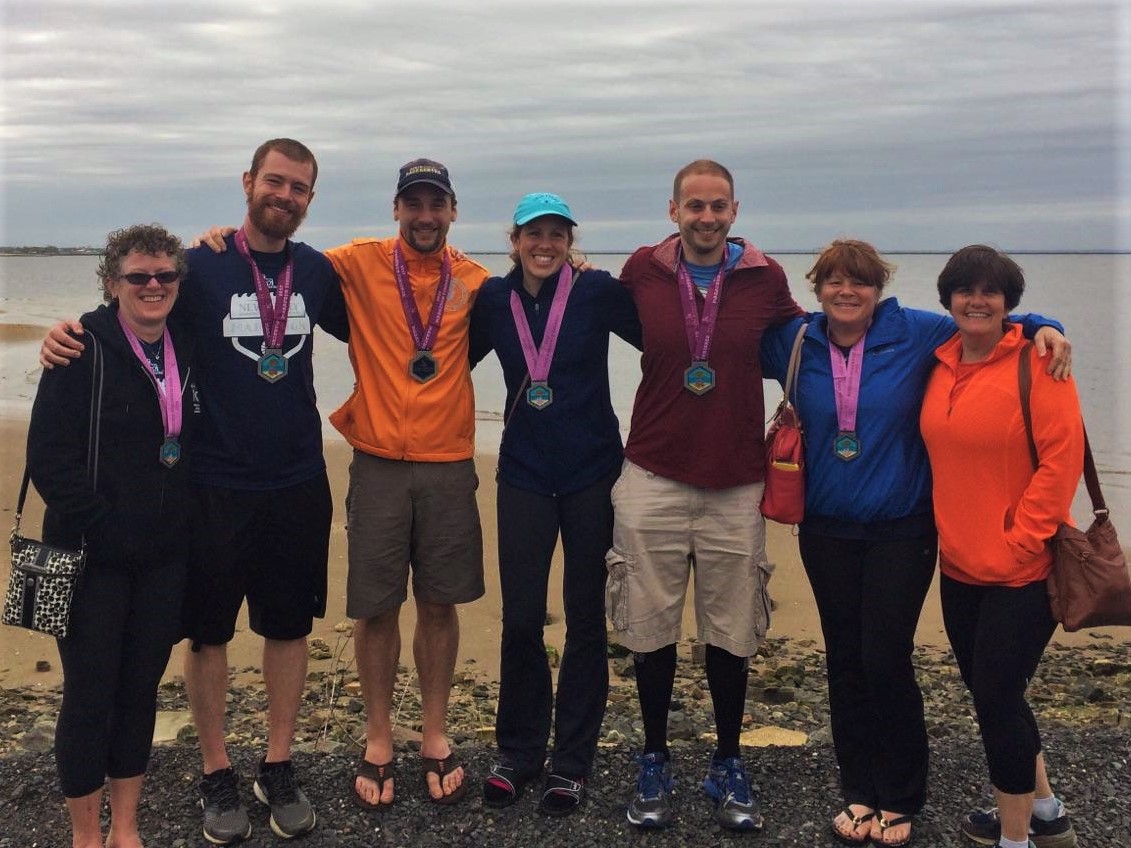
The Thorpe, Dresser, Finn crew with our fancy medals

Julie, Andrew, Me, Alex, Scott, Mom, and Beth after our post-race meal.
There are 5 PR's represented in this picture!

What worked:

My gear all performed admirably. I wore my Salomon shorts, a Tesla compression shirt, and synthetic Injinji socks, and had no issues with blisters or chafing. Due to Achilles concerns, I used an old pair of Brooks Glycerins, which have a larger heel drop than my usual Altras. The lack of Achilles pain afterwards suggests that this was a good idea. I also used a FlipBelt to carry my gels instead of cramming them all in my shorts or arm sleeves. This worked really well.

My nutrition worked pretty well, despite the fact that I hadn't practiced with it at all this year. I ate a Gu gel every 4 miles and was able to stomach it without any issues. I didn't carry any fluids, but still finished the race feeling well hydrated. I hit the wall at the end, but I think this was a result of pacing rather than a lack of calories.

What didn't work:

While my weekly mileage was higher than ever, my speed work was not sufficient to prepare me for race pace. I need to spend more time at marathon pace (or faster) during my training runs. Perhaps scheduling a tune up 10K or half marathon would have helped with this. But that will all have to wait a few months, because I'm now transitioning into full-on mountain mode for my summer races.

I enjoy running with pacers, but I need to stay far enough behind the pack that I can run the tangents. This probably didn't cost me much time, but it meant that I had to expend a little more energy at every turn to stay with the pace group. My pace and perceived effort in the early miles reflects this.

Worryingly, I started having negative thoughts very early in the race, as I began to rationalize why I wouldn't hit my goal time. Perhaps I was just being realistic, or perhaps this is what happens when I focus to intently on hitting exact mile splits. Either way, there were a few very depressing moments in this race, and I'd like to avoid that in future races. Maybe better race-prep would help with this.

Next Up

I'm going back to the mountains for the North Face Endurance Challenge: Bear Mountain 50 miler on 5/13. Then I get a month to recover before the daunting Manitou's Revenge 54 miler in the Catskills.

Tuesday, April 25, 2017

Breakneck Point Marathon

To put it briefly, this is just a really cool course.

Race director Ian Golden marking the course
Photo by Mountain Peak Fitness

Background

In 2016 Alex and I discovered the Breakneck Point Half Marathon, organized by New York's Red Newt Racing. From a training standpoint, it made absolutely no sense for me to participate that year. I was coming off a 26+ hour effort at the NJ Ultra Festival two weeks prior and I had the NJ Marathon two weeks afterwards. My legs still hadn't recovered, and I wasn't sure how I would respond mentally to another technical course. We both ended up having a blast, and we were extremely impressed with the quality of the race.

So if the half marathon is fun, the full marathon should be twice as fun, right?

I had a pretty good training block leading up to the race this year, peaking at 70 miles per week with 10,000 feet of elevation gain. I spent a few Saturdays in early April doing hill repeats at Mount Tammany to work on my uphill hiking and technical downhill running. As it turns out, both of these skills had degraded after a winter spent almost exclusively on roads.

Refining my technique one mistake at a time

By race day, I was feeling pretty confident and was ready to spend a day in the mountains.

The Course

The marathon course consisted of three loops which were connected by out-and-back sections.

Breakneck Marathon course map
Loops labeled in the order that they were run

 The six major climbs were:
  1. Unnamed Hill
  2. Breakneck Ridge
  3. Bull Hill
  4. South Beacon Mountain
  5. Lamb's Hill
  6. Unnamed Ridge
Each of these had its own particular challenges, the details of which will be discussed in painstaking detail later in this post.

Not for the faint of heart

Pre Race

Alex and I drove up on Friday night to avoid getting up ludicrously early on Saturday. We set up our tent in the dark and got to sleep a little after midnight.

Tent City
Photo by Stacey Parthenon

At 5am, we woke up to a very wet tent and sleeping bag. Not the greatest beginning to the day, but it was enough encouragement to get us up and moving. We got dressed, heated up some bagels and coffee over our backpacking stove, and then huddled in the car with the heat running until it was time to start.

The morning was a brisk 40-something degrees, but the forecasts called for partly sunny skies with temperatures in the mid-60's. I was chilly in my shorts and short sleeves at the starting line but knew I'd feel fine once I started running.

I had a few minutes to catch up with Charlotte Dequeker, Jay Lemos, Julian Vicente, and a few other running friends at the starting line. Charlotte had just recovered from an injury that had limited her running over the winter and seemed excited to start her racing season. Jay was coming off a very solid 2nd place finish at the rugged Mount Tammany 40 miler and looked to challenge for a top-10 spot at this race. Julian had finished Grindstone last year and paced Jay at Tammany, so his ability to run technical terrain was clearly on point.

With the NJ marathon coming up only two weeks later, I told myself that I was going to treat this like a long training run. I planned to hold back enough that I could resume my marathon training plan immediately after the race. Since I had run the half marathon course in under 3 hours on tired legs last year, I figured I could run the full marathon in 6-7 hours without killing myself.

Let's do this thing!

We started at 6:30 as a mass wave. The first couple hundred feet took us uphill through a grassy field before we were funneled into a single track trail. Everyone jockeyed for position to avoid being caught in the ensuing log jam.

The crazy ass start to the race
Photo by Mountain Peak Fitness

After some shuffling of positions in a first few tenths of a mile, I settled into a jogging pace on the first long uphill. Miles 1-2 were "douche grade" climbs, to borrow a term from the East Coast Trail and Ultra podcast, which is to say that they were too steep to run comfortably, but not steep enough that I would allow myself to hike.

During the climb, I ended up chatting with Julian and Chang Hyun, another Grindstone veteran who turned in a stout sub-24 hour performance last year. It turned out that we were also all planning to run Manitou's Revenge 54 miler in June, so we bonded over our mutual love of brutally difficult races. Chang and I would end up running the same pace almost the entire day and leapfrogging each other every few miles.

At mile 2.5, we topped out on the unnamed hill and had a couple miles of rocky running along a ridge line. A long runnable downhill then brought us back to Route 9D and the first aid station at the base of Breakneck Ridge. With an hour elapsed, I still had a full bottle of Tailwind on me, and I passed through without stopping.

Feeling fresh, I began the course's signature climb: an 1,100 foot class-4 rock scramble up Breakneck Ridge in only 0.7 miles. For those of you keeping score, that's a 30% average grade, which is steeper than Barkley's Rat Jaw (27%). In places, the climb is so rocky and exposed that EMTs were stationed on the course in case climbers injured themselves.

Runners scale Breakneck Ridge
Photo by Brian Newcomer

Much of the climb required the use of all four limbs and my undivided attention. I reminded myself to pause and take in the views every few minutes (which also afforded me the opportunity to catch my breath). The exposed ridge offered a vast panorama of the Hudson Highlands.

View from one of the false summits of Breakneck
Photo by Alex

Breakneck Ridge is a tough climb physically, but it can be even more mentally taxing since there are several false summits. Imagine this, you just scrambled up hundreds of feet of exposed rock face on all fours. Your watch beeps, reminding you that the last half mile just took fifteen minutes (Note to self: half mile splits are wholly unnecessary in a trail race). You finally reach what you think is the top of the climb, and you look up to see this looming above you.

Well shit.
Photo by Brian Newcomer

Thankfully, I have now done this climb a handful of times and I'm familiar with the various landmarks. Of course, that didn't make the physical aspect of it any easier. After 29 minutes of climbing, I finally reached the true summit. I had gone exactly one horizontal mile in that time.

On the ensuing descent, I had to consciously remind myself that I was capable of running. Moving my legs at a high cadence felt unnatural after half an hour of crawling on all fours. Gradually, my pace picked up, and I was able to pass a few people on the rocky descent. We continued downhill for three miles, losing every inch of the 1,200 feet of altitude that we had just worked to gain. The descent brought us to aid station 2 with 10 miles and 2:15 elapsed in the race. I refilled both water bottles and swigged a couple cups of Coke (a.k.a. rocket fuel) before hitting the trail again.

Next on the agenda was Bull Hill, a 1.7 mile 1,400 foot ascent on more rocky terrain. There's an interesting story behind the name of this mountain that bears telling:
"There used to be a wild bull that terrorised [sic] the country back of that hill for many a day, till at last a strong hunting party undertook to hunt him down and slay him. Forced to flee before his pursuers, he made one final, mad rush for the very crest of the hill and plunged into space, to leave his magnificent body a broken and shapeless mass on the rocks below and his name as a legacy to the mountain he used to haunt."
The Hudson River from Ocean to Source by Edgar Mayhew Bacon, 1902
How badass is that!

Anyway, I somehow ended up between Julian and Guillermo Ayala (yet another Grindstone vet) on this climb, and they heckled each other the entire way up the mountain, calling each other gringos and making fun of each other's pace. Listening to them was a fantastic way to pass the time as we marched steadily upward.

The summit was characterized by large rocky slabs which made running fairly easy. However, the 800 foot descent was much more technical, which played to my strengths. I passed a handful of people in this section, flying down with reckless abandon. By the bottom of the descent, we had eclipsed the half way mark in the race as well as two of the three loops. I had hit 13.1 miles just over the three hour mark and figured I was on track for a 6 hour finish if things went well.

We backtracked along the out and back section of the course for a few miles and then made a short but steep ascent of South Beacon Mountain. The highest peak in the Hudson Highlands, this mountain offered a full 360 degree view of the surrounding area. I again paused for a moment to take it all in. The weather was a perfect 60 degrees, with just enough clouds to keep us from overheating. It was one of those moments that reminds me why I run races like this.

View from South Beacon Mountain
Photo by Alex

On the short descent, I ended up running with Sayard Tanis, a total rock star of a runner from Pennsylvania with many wins and a few course records to her name. I figured if I was near her at this point in the race, I must be running well. We stayed together for about a mile as the course circled the scenic Beacon Reservoir. She stopped for a moment to tend to an issue with her ankle, and I continued ahead, running alone for the first time in the race.

After leaving the reservoir, I was greeted by a steep 800 foot descent down a hot dusty fire road. The last few hundred feet were at a grade of approximately minus infinity percent. In the span of seven minutes, my quads went from feeling fresh to being totally shredded. I created a Strava segment for this specific 0.7 mile section:

I do not hold the course record on this segment

At the bottom of Stupid Hill, Chang caught up to me and we complained to each other about how much that sucked. In fact, the brutality of that hill would become a common talking point among marathon finishers after the race.

Thankfully, the subsequent climb followed a picturesque waterfall up the slope of Lamb's Hill. I stopped in a few places to splash the cool water in my face and soak my hat. The climb was shaded, and my body temperature slowly returned to normal.

This makes up for Stupid Hill
Photo by Philip Pagdanganan 

As we climbed, it was becoming clear to me that the second half of the marathon would not be any easier than the first. Despite not having any Breakneck-esque climbs, the second half was relentlessly hilly and technical. Of course, I reminded myself, this is what I paid for.

Chang and I summitted Lamb's Hill (mile 20ish) together and began a rocky ridge line traverse to Bald Hill. He gave me some pointers on surviving Manitou's Revenge (which I'm really excited about). Traversing the ridge at 1,500 feet, we had spectacular views of the surrounding area, but the terrain was rocky enough that it occupied most of our attention. We parted ways before reaching Bald Hill, and I began what I thought was the final descent. I was around mile 23 and knew that the last 2-3 miles were all downhill. 23 plus 3 is 26, which is the length of a marathon. So I was almost done. That wasn't so bad!

I started to reflect on the awesome day that I'd had in the mountains, feeling thankful for another year of great weather and for the fact that I hadn't gotten off course today. I drank the last few drops of water in my bottle, knowing that there was an aid station 2 miles from the finish. All of a sudden, the trail started to go uphill. Wait... what? I was climbing again?

Poor sense of direction or not, I knew I hadn't gone off course. I figured that the climb must be just a few tenths of a mile and then we would really start the final descent. Five switchbacks and 500 feet of climbing later, I realized I was wrong. The trail finally leveled off and traversed another technical ridge for a mile and a half, climbing and descending several rock piles. I passed a few equally puzzled runners who wondered aloud if we were off course. They clearly didn't know who they were asking.

Finally, with 26.0 miles showing on my watch, I came to the final aid station. I had gone 30 minutes without water and was ravenously thirsty. A volunteer filled my water bottle and then had to fill it again when I gulped the entire thing down in seconds.

"Wow, someone's thirsty!" she said to me.

"Yeah... I think that last section ran a little long," I replied.

"We've been hearing that a lot," she informed me.

With only two miles left to go, I didn't stick around long. I took off on the real final descent, following the rocky fire road that we had started on.

I described this section as "douche grade" climbing going uphill at the beginning. Going downhill was another story. Losing 350 feet per mile, this stretch of trail was the perfect grade to run effortlessly. My only concern was placing my feet between the rocks and branches that littered the trail. I flew through here with some of my fastest miles of the day.

A mile from the finish, I crossed a perfectly clear creek that beckoned me. I was hot and covered in salt, and I really wanted to splash more water in my face. My racing instincts told me to hammer the final mile and see if I could pass anyone else. My self preservation instincts told me to save that kind of effort for another race. Self preservation won, and I happily cooled off in the water for a few seconds before gliding downhill for the final mile.

Now where's that keg at?
Photo by Alex

I crossed the finish line in a time of 6:32:57, good for 23rd of 153 finishers. This "marathon" (which my GPS measured at 28.1 miles and 9,700 feet of climbing) had taken me longer than any recent 50K aside from the Barkley Fall Classic. A perfectly brutal course!

The post race festivities were characteristically enjoyable. I grabbed a few slices of pizza and more than a few drinks from the keg that was waiting at the finish line pavilion. Alex had finished the half marathon just seconds under her 4 hour goal, and we sat in our double camp chair watching the remaining runners trickle in.

All in all, this was a fantastic race. The trails were uniquely rugged, the scenery was amazing, and the course was impeccably marked. Red Newt Racing has really created something special with this event, and I look forward to coming back every year.

Thursday, March 23, 2017

Febapple 50, Lenape 50K, and NJ Ultrarunning

New Jersey ultrarunning is getting fast, and that's pretty cool.

(And no, I'm not talking about myself)

I'm going to spoil the ending of these race reports and list the results right off the bat. The short story is that I'm a little faster than I was last year, but NJ ultra races are getting more competitive. So here are my finishing times and overall placing of my last three ultras compared to the previous times I ran them.

Race
Previous Time
(Place)
Recent Time
(Place)
Frozen Fools 50K*
6:10:58 (1)
5:58:42 (2)
Febapple 50
9:17:16 (3)
8:46:23 (5)
Lenape 50K
5:49:16 (3)
5:30:46 (5)

In each race, I finished 10-30 minutes faster than the previous year, but my overall placing declined. Now, to be perfectly honest, I'm competitive enough to be a little disappointed by this. On the other hand, it's also really exciting to see the fields in these races get a little faster from year to year.

Food for thought. Now, on to the race reports!

*Frozen Fools race report can be found here


Febapple Frozen Fifty

Febapple is a fun early season race organized by Rick and Jennifer McNulty of NJ Trail Series. For the last two years, it has been my way of testing my training and nutrition plan before the spring racing season begins. I also signed up for the sake of vanity, in the sense that I needed a 50 mile result to boost my standing in the Ultrarunning Race Series. Last year, I was on pace for a 9 hour finish, but slowed down over the last 20 miles. This year, after a solid training block and no injuries, I was hoping for sub-9 hours with even splits.

Febapple Course Profile

The course is a 10 mile figure-8 loop through South Mountain Reservation consisting of a 4 mile leg and a 6 mile leg. Each full loop has three climbs and descents of about 300' each, for a total elevation gain of ~6,000' over the 50 mile course. The course a mix of asphalt, fire roads, and single track, most of which is runnable, but technical enought to give veteran trail runners a small advantage (well, not always). I set a goal of 1:45:00 per loop (10:30/mi) for the early loops and 1:50:00 (11:00/mi) for the later ones.

Got my game face on. Let's do this!
(Note the dude in short shorts. You can tell he's fast.)

Toeing the line at the 7am start was a talented mix of local runners: Christoffer Johnston (2:50 marathoner), Tsukasa Kawarai (2:58 marathoner), Jesse Wolfgang (3:05 marathoner), Ryan Timme (3:06 marathoner), John Fegyveresi (Barkley Marathons finisher), John Jenkins (18:22 100 miler), and Scott Gregor (23:07 Grindstone finisher). Whew! Compared to my relatively pedestrian 3:17 marathon PR, this was a blazingly fast field. I immediately picked Christoffer Johnston to win the race on the basis of his super short shorts (spoiler alert: I was right!).


The start of the race. So far so good!

At precisely 7am, we were off! The temperature was a brisk 30 degrees, but the weather reports promised highs in the mid-50's and cloudy skies, which is perfect running weather. I settled into a sustainable 9:00/mi pace on the flat first mile while a stream of other runners whizzed by me and quickly went out of sight.

"These doofuses are going out way too fast," I thought to myself, expecting to reel in most of them by the end of the day (spoiler alert: I was wrong!).

After a mile of asphalt, the course plunged downhill on the most technical descent of the day. I've been training on roads all winter, and I'm happy to say that my legs handled the transition to single track really well. I clicked off a 8:39 mile through this section. The next two miles were all uphill back to the aid station. I put my head down and powerhiked (i.e. walked) to conserve energy. I passed a few people in this section, which surprised me since uphills are usually my weakness. However, this section would consistently be my slowest, as I trudged to 12:17 and 12:54 mile splits for miles 3 and 4.

One of the nicer sections of the course
Photo by Stephanie Ruzicka

After 42 minutes, I was back at the start and I immediately began the 6 mile leg of the loop. After a brief flat section, the course again plunged downhill on a wet, snowy single track trail. In 2016 this section had been solid ice, and I had to brace myself on trees to stay upright. This year, the snow was soft enough to get traction, although some concentration was required. At the bottom of the descent was a small creek crossing where I managed to keep my feet dry, after which the course climbed for 2 miles on a runnable fire road. I covered these miles in about 11:00 each, and then opened up my stride on the ensuing runnable downhill (9:10/mi). Miles 9 and 10 had a steep rocky uphill and then a rutted fire road leading back to the start/finish, which I covered in 11:53 and 10:13. I crossed the timing mat at 1:44:30 for my first loop - right on pace!

And the crowd goes wild!

My nutrition plan for the race was simple: 250 cal/hour in Tailwind, mixed with 20 oz. of water. This meant that I only had to swap out my two empty water bottles for two new ones at each 10 mile interval. My crew, consisting of Alex and my mom, was cheerful and efficient as always. I probably stopped for 5-10 seconds each time I came through, which was just long enough to grab the new bottles and give Alex a kiss. I figure I spent about one minute total with my crew during the race.

Laps 2 and 3 went by like clockwork, and I churned out splits of 1:43:59 and 1:44:38. While I was out, Alex ran the 10 mile race, finishing 13th woman out of 41 (she's running her first 50K in May and is going to kill it!).

Rocks and snow and more rocks
Photo by Stephanie Ruzicka

As I finished mile 30, I asked Alex to tell me what place I was in the next time I came through. I was still running strong, and was convinced that I was headed for a top-3 finish. This loop was when I first started to hurt a little bit. As the temperature increased, the snow on the course melted and turned to mud and slush. The footing became difficult, and my legs became less nimble in these tricky sections. Somewhere in this section, I passed Ke'Mani Smith, who you may remember from previous race reports. He was having a solid race in the 50K and would improve on his previous year's time by almost 30 minutes! We had the following brief exchange:

Me: Hey Ke'Mani!
Kemani: Hey buddy! Are you in the lead?
Me: Actually I have no idea.
Kemani: Well you're first in my heart.

I continued on with a smile on my face. Despite my perceived struggling, I finished the loop in 1:47:25, only 3 minutes slower than my previous loops.

Back at the timing mat, Alex informed me that I had seven runners in front of me, four of which were totally out of reach. Seven?! Holy crap! And here I was thinking I could cruise in for a podium finish.

I hit the trail, determined to pass a few more people before I finished. I ran almost every step, no longer worried about saving my legs for later. The sun felt like it was beating down on me at this point. It's funny how warm 50 degrees feels after training all winter. I scooped up a handful of snow and packed it under my hat to cool myself down. I grabbed another handful and ate it like a little kid who just built a snowman. It was probably dirty, but it was delicious! I passed a few runners on the trail, but it was impossible to tell which race distance they were running. By the time I reached the final climb, I was gasping for air as if I was finishing a 5K. I felt like Zach Miller finishing the North Face 50 mile championships (you know, if Zach Miller was a few years older and much less athletic).

Show of hands - who wants to sit down and have a beer?

I crossed the finish line in 8:46:26 with a final loop split of 1:45:45. I finished in 5th place, having passed 3 people in the final loop. Here's the crazy part: the top three finishers (Christoffer Johnston, Scott Gregor, and John Jenkins) were all about an hour ahead of me. I never had a chance against these guys! The fourth finisher (Ryan Timme) was not far behind them.

Surprisingly, the winning time of 7:45:45 was not a course record. However, the runners ahead of me ran the 3rd, 4th, 5th, and 7th fastest times in the seven year history of the race. In fact, my finishing time would have won the race outright in four other years (granted, the trail conditions were significantly worse some years). I can only hope that the level of competition at this race continues to rise over the next few years so we can push each other to be better and better.

What worked well:
  • My crew is a well oiled machine. They have everything down to a science and are relentlessly upbeat whenever I see them.
  • My nutrition was almost perfect. I never felt nauseous or had trouble taking in calories. I probably should have had more water (hence eating a snowball), but this wasn't a major issue.
  • My training is really paying off. Unlike last year, I wasn't battling any nagging injuries, and I was never worried about how my body would hold up over the distance. I felt strong on the climbs and descents all day and was able to do 8 miles of hiking and running the next day.
  • My pacing was spot on! This is the best ultra I've ever run in terms of maintaining consistent splits. My fastest and slowest 10 mile splits were only 3 minutes apart (10:24/mi vs. 10:45/mi).
  • My gear held up really well. The new Altra Lone Peaks seem to be much more durable than their predecessors, and OH MY GOD HAVE YOU GUYS TRIED WATERPROOF SOCKS? I was skeptical of how well they would work, but my feet stayed dry and blister-free despite snow, mud, and countless puddles on the course.
What needs improvement:
  • My fitness is still just average. I'm able to be competitive in local races because I plan obsessively and I can maintain a solid pace on technical terrain. If I'm going to improve in this sport, I need to get faster.
  • My power hiking needs some work. I lost a little bit of time in this race because I was not very strong on the uphill sections. I would attribute this to a lack of trail running this year.
  • My sense of direction still sucks. I didn't mention this, but I lost 2 minutes because of a wrong turn early in the race. I didn't finish within 20 minutes of another runner, but in a closer race this could have cost me (see Lenape race report below).


Lenape Run 50K

The Lenape Run is a small fatass style run, which has quickly become one of my favorite local events despite featuring two of my main weaknesses: road running and navigation. The course starts in the Ironbound district of Newark and follows roads, park paths, and trails to South Mountain Reservation (yep, the same one from Febapple). Since this race was only two weeks after Febapple, I decided to treat it like a long training run, although I was hoping to finish in the top 3 and receive one of the hand-made wooden trophies that Jay Lemos had brought.

Lenape Course Profile

We parked at the finish line and boarded the 6:50 train to Newark (after a frantic scramble resulting from the train arriving on the wrong side of the track). On the 30 minute ride, I caught up with "Crazy" Dan O'Keefe, who organizes the Frozen Fools 50K fatass and recently ran the epic Inca Trail Marathon. I also chatted with Anthony Longano, who had finished his first 100 miler since the last time I saw him. One of the cool things about this race is that most of the runners are training for some big event later in the year, so it's always fun to compare race schedules. We arrived in Newark at 7:17, made our usual pilgrimage to the small train station bathroom, and took a quick group picture.

The group picture is not just a fun tradition. It's also the best way of accounting for all the runners who start.
Photo by Anthony Longano

By 7:30, we were off on our adventure. The temperature was a chilly 23 degrees with a wind chill in the mid-teens. That was all the incentive I needed to hammer out a quick first few miles. I was almost immediately passed by Jay (who holds the course record) and a few other runners, but kept my pace around 8:30/mi, figuring I could turn on the afterburners later if necessary.

Early miles in Branchbrook Park
Photo by Anthony Longano

I found myself running with Chris McGovern and Joe Limone, who I know from previous races. Our running pace matched nicely, and we stuck together for much of the first 13 miles, which were almost entirely on asphalt. At mile 3, we passed through Branchbrook Park on a pedestrian pathway just as a bike race was beginning. We then ran north through the suburban streets of Belleville and Nutley and crossed the scenic Yantecaw River in Booth Park (and then crossed back over a handful of times). At mile 9, we crossed the Garden State Parkway on a pedestrian bridge, then hopped over a barricade marked "Bridge Out" to cross the Yantecaw River yet again (the bridge was fine, but closed for unknown reasons).

Crossing the Garden State Parkway
Photo by Anthony Longano

We then passed through Brookdale Park and through the streets of Upper Montclair. Finally, we left the roads and entered the singletrack of Mills Reservation. I began to pull ahead of Chris and Joe, but unfortunately had to pull over to answer the call of nature, falling behind them by a few minutes. I caught back up a couple miles later, which surprised them both since they thought I had been ahead. This would continue to be a theme all day.

At least it was pretty in some spots!
Photo by Anthony Longano

I felt good on the technical terrain and again pulled ahead by a few minutes as we followed the West Essex Trail through Cedar Grove. Shortly after, I caught up to Barry Janay and Konstantin Walmsley, who were moving extremely well, but had stopped to grab some food from the mile 17 aid station. I was carrying everything I needed for the day and passed through, unwilling to stop moving in the cold weather. This put me in 3rd place momentarily, but they would pass me back a few miles later.

Circling Verona Lake
Photo by Anthony Longano

We returned to the roads around mile 19 and entered downtown Verona, ran a loop around the scenic Verona Lake, passed through a residential area, and then left the roads again at Eagle Rock Reservation. Once again, I was back at home on some smooth single track trails and laid down a few sub-9:00 miles, keeping my eyes focused on the ground in front of me. I passed Barry and Konstantin, who had stopped to have a snack. They offered to share their food, but I was still worried about freezing to death if I stopped for too long.

Around mile 24, I suddenly looked around and realized that I hadn't seen any yellow Lenape blazes in a while. I also realized that I should have left the reservation around mile 23. Crap! I backtracked half a mile and found the turn that I had missed. The detour had cost me just under a mile of extra running and 7.5 minutes of time. I was sure that Barry, Konstantin, Chris, and Joe had all passed me while I was off course.

Whoops!

Thankfully I was still moving well, and I still had a shot at finishing somewhere around 5 hours. I just had to stay on course... I made quick work of the road miles through South Orange and hit the marathon mark (on my GPS anyway - it was mile 25 for everyone else) at around 3:55 elapsed time. From here, the course climbed 200 feet up a steep overgrown powerline cut.

Bam!
Photo by Anthony Longano

Those of you who read my Barkley Fall Classic race report will know that I have some prior experiences with these types of climbs, and I have a love/hate relationship with them. Okay, that's a lie. I freakin' love power line cuts. Nothing makes me feel more badass than bushwhacking up a steep climb. I powered up the hill (pun intended) and caught up to Barry and Konstantin at the top. One of them (I can't remember who) was cramping and I made sure they were okay before continuing on. Now I just had to hunt down Chris and Joe so I could collect that sweet hand-made 3rd place trophy.

I caught up to them around mile 28 and they once again expressed their surprise at seeing me since they thought I ahead. I mumbled something about getting lost once in every race, but thankfully that excursion was behind me! We ran together for the next few miles on the newly completed single track section that crested Mayapple Hill in West Orange. I put a small gap between myself and them, finally back in sole possession of 3rd after six miles of catching up.

Then I got lost again.

Whoops!

Okay, hear me out before you start judging! Jeez!

I was 5 hours into a freezing cold race, so my mind was a little addled to begin with. I came to a junction in the trail. One direction had yellow blazes which were a slightly lighter shade of yellow than the ones I had been following. The other direction had orange blazes. I remembered having this issue in previous years, but couldn't remember which way was correct. I thought to myself it would be stupid to have a light yellow trail intersect a dark yellow trail. Clearly, light yellow and dark yellow are the same trail.

Are you still judging? Well, there's just no pleasing some people.

The short story is that I followed the light yellow trail, when in fact I should have followed the orange trail. This lesson cost me another 7 minutes, 0.7 additional miles of running, and two unnecessary river crossings. I shouted a few obscenities at no one in particular when I realized this.

Back on track. Needless to say, all four people who I had passed were now in front of me, putting me squarely in seventh place. Luckily, the last 4 miles were all on single track, so there was a small chance that I could once again reel in the other runners. I caught up to Chris and Joe on a technical descent around mile 34. Rather than being surprised, this time they just seemed disappointed.

I caught sight of Barry and Konstantin a mile later, but they were still moving quickly. I red-lined my heart rate on the final climb, but couldn't make up any ground on them. They would later admit that they saw me running toward them and pushed hard to avoid being passed. The final technical descent was too short for me to make up any ground, and I finished in 5th place with a time of 5:30:43. I had run 35.8 miles in a 34 mile race.

So once again, my sense of direction has failed me. I lost 14.5 minutes and ran an additional 1.6 miles because of stupid mistakes. For reference, I ended up 13 minutes behind second place finisher Jesse Wolfgang (who you might remember from the Febapple report) and 17 minutes behind first place finisher Jay Lemos. I also missed out on a podium (i.e. cool trophy) position by 30 seconds. Such is life (for stupid people like me).

But here's the silver lining: this year's Lenape run is now responsible for 7 of the top 10 times ever run on the course! Like I said, NJ trail and ultra running is getting faster, and I'm really excited to see what next year brings.

Big thanks to Christian Focacci for organizing this event and to his fiancee (whose name I unfortunately forgot) for running the mile 17 aid station! And thanks to Anthony Longano for allowing me to use his pictures so this report isn't just a wall of text!

What worked well:

  • My nutrition was fine despite not being optimal. I carried four 20oz bottles in my pack, each with 300 calories of Tailwind. I drank one of these every 90 minutes, and the race was short and cold enough that I didn't mind the relatively small amount of water. However, I might try going even more minimal next year to cut down on weight.
  • My training was still fine, even though I only had two weeks to recover after Febapple. I didn't taper for this race, and didn't need any time to recover afterwards, running 77 and 66 miles in the next two weeks. If I can stay healthy, March will be my highest mileage month ever.
  • The runners were a lot of fun as always. One of my favorite parts of this race is hanging out in the parking lot afterwards, drinking beer, and talking to the other runners. This race really brings out a fun crowd!
  • My time off course improved from 15 minutes in 2016 to 14.5 minutes this year. Progress!
What needs improvement:
  • I don't know if I mentioned this, but my navigation skills could use some work. Despite printing out turn by turn directions and running the course twice previously, I still got lost. And this time, it cost me a cool trophy. I should really pay attention when I run.
  • My beer froze in my trunk and was impossible to drink after the race. This is unacceptable. Someone should invent a device that insulates beverages from their surroundings.


Next up...

I ended up not signing up for Looney Leprechaun 10K because of snow, and I decided to volunteer at Tammany 10 instead of running it, to avoid burning out too early in the season. That leaves three more spring races:
  • 4/15 - Breakneck Point Marathon
  • 4/30 - NJ Marathon
  • 5/13 - North Face Bear Mountain 50
Happy running!